EUDAMED · MDR · UDI/Devices
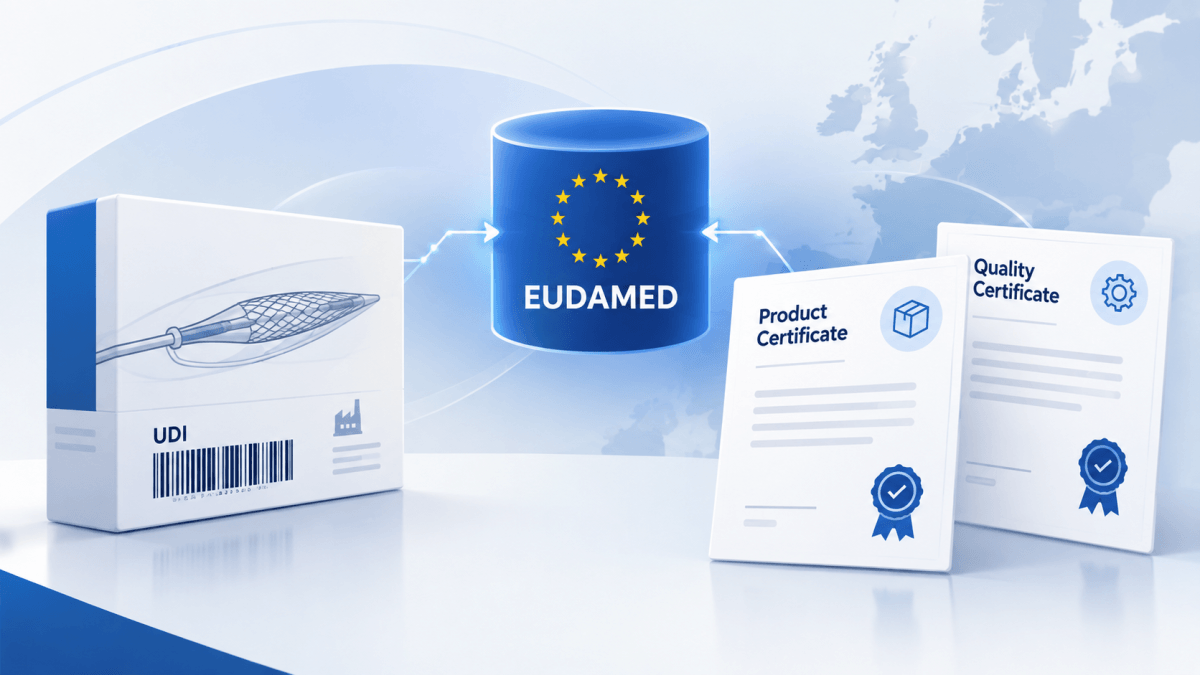
EUDAMED: Which certificates must be provided during UDI device registration?
Technical article · Last updated: 6 October 2026
Medical device manufacturers may hold several certificates issued by a Notified Body as part of their MDR conformity assessment. However, when registering a device in the EUDAMED UDI/Devices Module, not every existing certificate is automatically reported.
The relevant information depends in particular on whether the certificate is a Quality certificate or a Product certificate, the applicable MDR Risk Class, whether the device is implantable, and the conformity assessment route actually applied.
In short:
The existence of a Quality certificate does not automatically mean that it must be entered during the manufacturer’s UDI submission. The Certificate section of the UDI registration is not a complete list of all certificates held by the manufacturer. For specific device configurations, EUDAMED requires information on the relevant Product certificate.
Quality certificate or Product certificate – why does the distinction matter?
EUDAMED explicitly distinguishes between Product certificates and Quality certificates under the MDR. Both may be relevant to the manufacturer’s MDR conformity assessment, but they serve different purposes within EUDAMED.
Product certificates
Product certificates include in particular:
- EU technical documentation assessment certificate (Annex IX Chapter II)
- EU type-examination certificate (Annex X)
- EU product verification certificate (Annex XI Part B)
The scope of a Product certificate is product-related. The devices concerned can be identified through the corresponding Basic UDI-DIs within the Certificate Scope.
Quality certificates
Quality certificates include, for example:
- EU quality management system certificate (Annex IX Chapter I)
- EU quality assurance certificate (Annex XI Part A)
The scope of a Quality certificate can be considerably broader. It may include device groups, Risk Classes, Device Names or Catalogue/Reference Numbers and does not necessarily list every individual Basic UDI-DI held by the manufacturer.
Why is an existing Quality certificate not automatically reported during UDI submission?
A Quality certificate may confirm, for example, the assessment of a manufacturer’s quality management system. It can cover a large number of devices or entire device groups.
However, this does not automatically make it the Product certificate that EUDAMED expects for specific device configurations during the manufacturer’s UDI registration.
EUDAMED Business Rule BR-UDID-109 refers to the Type of product certificate associated with the device. Depending on the device configuration, the relevant certificates are in particular an EU technical documentation assessment certificate (Annex IX Chapter II) or an EU type-examination certificate (Annex X).
Important:
No Product certificate information in the manufacturer’s UDI submission does not mean that no certification is required. A Quality certificate may still be required under the applicable MDR conformity assessment route. It is registered by the Notified Body in the Notified Bodies & Certificates Module.
How is the link between a Certificate and a Basic UDI-DI created?
EUDAMED Business Rule BR-UDID-056 describes the automatic link between a Certificate and a Basic UDI-DI.
When a Notified Body registers a Certificate and the relevant Basic UDI-DI is explicitly referenced in the Certificate Scope, EUDAMED can automatically establish the link between the Certificate and the Basic UDI-DI.
If the Basic UDI-DI is not directly included in the Certificate Scope, this automatic link is not created.
Practical example:
A Quality certificate may cover a specific device group without listing every Basic UDI-DI within that group individually. This therefore does not automatically create a direct Certificate link to every individual Basic UDI-DI.
Which Certificate Information is required by BR-UDID-109?
Where Certificate Information is required for a specific device configuration, the following fields are particularly relevant:
Required where the applicable device configuration requires Certificate Information.
Required.
Optional for this submission.
Optional for this submission.
Decision guide for the manufacturer’s UDI submission
The required Product certificate information depends on the MDR Risk Class, the Implantable property, a possible IIb implantable exception, and the conformity assessment route actually applied.
The following cases relate exclusively to Certificate Information in regular MDR device registrations within the EUDAMED UDI/Devices Module.
MDR Class I / IIa
Implantable: depending on device
IIb implantable exceptions: Not applicable
UDI submission:
No Product certificate information is required under BR-UDID-109.
MDR Class IIb – non-implantable
Implantable: No
IIb implantable exceptions: Not applicable
UDI submission:
An EU type-examination certificate (Annex X) must be provided if the device is covered by such a certificate. If no applicable Type Examination Certificate exists, no Product certificate information is required.
MDR Class IIb – implantable with exception
Implantable: Yes
IIb implantable exceptions: Yes
UDI submission:
For the corresponding Annex IX route, no TDA Product certificate information is required. However, if the device is covered by an EU type-examination certificate (Annex X), the corresponding Certificate Information must be provided.
MDR Class IIb – implantable without exception
Implantable: Yes
IIb implantable exceptions: No
UDI submission:
An EU technical documentation assessment certificate (Annex IX Chapter II) or an EU type-examination certificate (Annex X) must be provided, depending on the conformity assessment route actually applied.
MDR Class III
Implantable: Yes / No
IIb implantable exceptions: Not applicable
UDI submission:
An EU technical documentation assessment certificate (Annex IX Chapter II) or an EU type-examination certificate (Annex X) must be provided, depending on the conformity assessment route actually applied.
Class IIb implantable devices: why the exception is decisive
Certificate logic for Class IIb implantable devices can easily be misunderstood.
The property Implantable = Yes alone does not determine whether a Product certificate must be provided. It is also necessary to determine whether the device falls under an applicable exception for Class IIb implantable devices.
Case 1: Implantable = Yes, IIb implantable exceptions = No
For a Class IIb implantable device to which no relevant exception applies, technical documentation assessment for the individual device is generally relevant under the Annex IX conformity assessment route.
In this case, the corresponding EU technical documentation assessment certificate (Annex IX Chapter II) is the relevant Product certificate.
An existing EU quality management system certificate (Annex IX Chapter I) does not replace this Product certificate requirement.
Case 2: Implantable = Yes, IIb implantable exceptions = Yes
Where the Class IIb implantable device falls under an applicable exception, the corresponding Annex IX route does not impose the same requirement for technical documentation assessment for every individual device.
In this scenario, the manufacturer’s UDI registration therefore does not include the corresponding TDA Product certificate information.
However, if the device is actually covered by an EU type-examination certificate (Annex X), the corresponding Certificate Information must still be provided.
Why “IIb implantable exceptions” must be maintained correctly
The device properties maintained in EUDAMED directly influence the Certificate logic applied during registration.
If an applicable IIb exception is not correctly reflected, the device may be treated as if Product certificate information were required even though it would not be required for the correctly maintained device configuration.
Practical point:
Before UDI submission, manufacturers of Class IIb implantable devices should verify not only the Risk Class but also Implantable, IIb implantable exceptions and the conformity assessment route actually applied.
2026 regulatory change: extended exceptions for Class IIb implantable devices
The regulatory framework for Class IIb implantable devices changed in 2026.
The Commission Delegated Regulation (EU) 2026/1359 extended the list of Class IIb implantable devices exempted from the obligation to perform an assessment of the technical documentation for every individual device.
Manufacturers assessing a current Class IIb scenario should therefore not rely exclusively on earlier lists of individual device types. The current MDR legal framework must be taken into account.
Note on the current documentation status:
The published Business Rule BR-UDID-109, Production v2.27.0 still partly uses the wording “sutures and staples”. The EUDAMED M2M documentation already uses the broader term “IIb implantable exceptions”. The current MDR legal framework should therefore also be considered when assessing the applicable regulatory exception.
What should manufacturers check before an EUDAMED submission?
1. Check the Risk Class
Is the device Class I, IIa, IIb or III?
2. Check Implantable
For Class IIb devices, the Implantable property is decisive for the next step in the Certificate logic.
3. Check IIb implantable exceptions
For implantable Class IIb devices, determine whether a currently applicable regulatory exception exists.
4. Check the Conformity Assessment Route
Determine whether Annex IX or Annex X was actually applied and which Product certificate covers the device.
5. Do not automatically submit every available certificate
A Quality certificate should not be confused with the Product certificate information required by BR-UDID-109 for specific device configurations.
No Certificate Information does not mean “no certification”
A manufacturer may hold all MDR certificates required for the applicable conformity assessment route even though no Product certificate information must be provided when registering a particular Basic UDI-DI.
Quality certificates remain part of the applicable conformity assessment procedure. They are managed in the Notified Bodies & Certificates Module and do not automatically become part of the manufacturer’s UDI submission simply because they are relevant to the company or its device portfolio.
Conclusion
For EUDAMED UDI registration, the decisive question is not:
“Which certificates does the manufacturer hold?”
The relevant question is:
“Which Product certificate information does EUDAMED require for this specific device configuration?”
Quality certificates may be mandatory under the MDR conformity assessment process without automatically being entered in the Certificate section of the manufacturer’s UDI submission.
Frequently asked questions
Must an EU quality management system certificate be entered during EUDAMED UDI registration?
Not merely because it exists. BR-UDID-109 requires Product certificate information for the device configurations defined by the rule. Quality certificates are managed in the Notified Bodies & Certificates Module.
Does “no Certificate Information required” mean that no Notified Body certification is required?
No. The Certificate requirements of the UDI registration must be distinguished from the MDR conformity assessment requirements applicable to the device.
Which information is required when Certificate Information must be provided?
In particular, Type of Certificate and Notified Body ID. Certificate ID and Revision Number are optional for this submission.
Why is “IIb implantable exceptions” so important?
For Class IIb implantable devices, the applicable exception affects whether Product certificate information is required for the conformity assessment route actually applied.
This article covers regular MDR devices registered in the EUDAMED UDI/Devices Module. Legacy Devices, IVDR devices, Custom-made Devices and other special scenarios are outside its scope.
Sources and regulatory basis
-
European Commission – EUDAMED Certificates Module Training
DG SANTE, Unit R4 – Information Systems, November 2025.
Relevant in particular to the distinction between Product certificates and Quality certificates and the MDR Conformity Assessment Routes.
Official EUDAMED source
Accessed: 6 October 2026. -
European Commission – EUDAMED UDI/Devices Business Rules
Production v2.27.0.
Relevant in particular: BR-UDID-056 and BR-UDID-109.
Official EUDAMED source
Accessed: 6 October 2026. -
Commission Delegated Regulation (EU) 2026/1359
of 20 March 2026 amending Regulation (EU) 2017/745 as regards the list of Class IIb implantable devices exempted from the obligation to perform an assessment of the technical documentation for every device.
Official EUR-Lex source
-
European Commission – EUDAMED M2M User Guide
Relevant in particular to the IIb implantable exceptions device property.
Official EUDAMED source
Accessed: 6 October 2026.
EUDAMED documentation and Business Rules are updated periodically. Manufacturers should always verify the latest system documentation and the regulatory requirements applicable to the specific device before registration.







Related Posts