Last updated: 30 September 2026
The Master UDI-DI groups specified highly individualised medical devices according to relevant design parameters. It reduces the number of identifiers to be registered in EUDAMED while retaining the information needed for traceability. Contact lenses and spectacle products have separate implementation dates and technical registration arrangements. [1]
Key implementation dates
| Product category | Mandatory Master UDI-DI application | Regulatory reference |
|---|---|---|
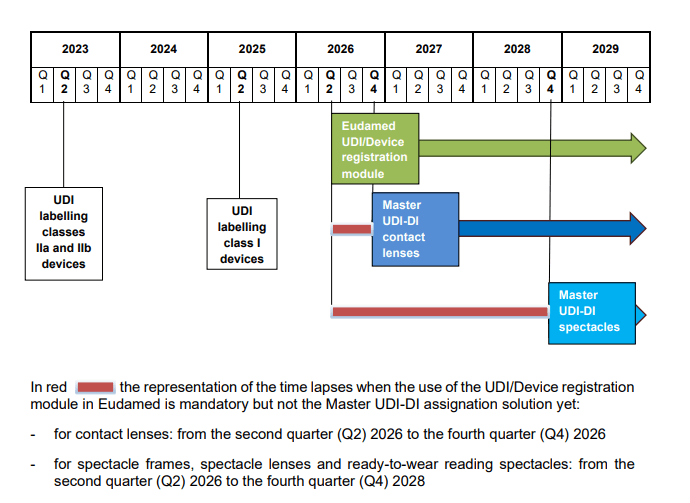
| Contact lenses within scope | 9 November 2026 | Delegated Regulation (EU) 2023/2197, as amended by (EU) 2025/788 |
| Spectacle frames, spectacle lenses and ready-to-wear reading spectacles within scope | 1 November 2028 | Delegated Regulation (EU) 2025/1920 |
MDCG 2025-7 Rev. 1 explains these dates and their relationship with labelling and registration. Manufacturers may assign Master UDI-DIs earlier under the applicable framework. Contact lenses produced before 9 November 2026 do not require retrospective Master UDI-DI labelling. [3]
Basic UDI-DI, Master UDI-DI and UDI-PI
These identifiers serve different purposes:
| Identifier | Function |
|---|---|
| Basic UDI-DI | Links the device model to EUDAMED records and regulatory documentation. It remains required and is not printed on the label. |
| Master UDI-DI | Performs the UDI-DI role for the relevant group of highly individualised devices. It is linked to a Basic UDI-DI. |
| UDI-PI | Identifies production information, such as the lot, serial number or relevant dates. |
For contact lenses, the UDI combines the Master UDI-DI with the applicable UDI-PI. [1] [2]
Which contact lenses are covered, and how are they grouped?
Standard and made-to-order contact lenses are covered. Devices qualifying as custom-made under the MDR are excluded from the UDI system. Made-to-order lenses must therefore be distinguished from regulatory custom-made devices. [4]
For standard contact lenses, grouping uses manufacturer-defined design parameters, including at least base curve and diameter, plus other relevant parameters. One identifier cannot automatically cover an entire commercial product family.
For made-to-order contact lenses, grouping follows the combination of design parameters; their actual numerical values need not be included in the assignment. MDCG 2024-14 Rev. 1 recommends a unique lot or serial number as the UDI-PI. [2]
What changes on contact lens labels?
The UDI carrier provides machine-readable information (AIDC) and its human-readable interpretation (HRI). An existing barcode may need updating; labels without a suitable carrier need one added. A 2D DataMatrix is one implementation option. [4]
In the GS1 system, AI (8014) carries the Master UDI-DI for standard contact lenses, while AI (03) is used for made-to-order lenses. These are GS1 application identifiers, rather than universal identifiers for every issuing entity. [5]
Scanning software must correctly process the revised codes. During the transition, supply chains may encounter both labels containing a Master UDI-DI and earlier labels without one. [4]
How does this relate to mandatory EUDAMED use?
The UDI/Device registration module became mandatory on 28 May 2026. However, MDCG 2025-7 Rev. 1 explains the specific timing for devices covered by Master UDI-DI: labelling and registration follow the assignment obligation. Early voluntary assignment is followed by labelling and registration.
Manufacturers should assess these linked obligations together, rather than apply a general EUDAMED date to every optical device. [3]
EUDAMED registration and M2M: distinguish device categories
The published EUDAMED UDI Devices user guide, Production v2.27.0 (2026), documents Master UDI-DI registration for standard and made-to-order contact lenses, both soft and rigid gas permeable.
The registration process includes special rules. For example, Direct Marking UDI-DI and Unit of Use DI do not apply to Master UDI-DI records. Data templates and validation rules should reflect these differences. [6]
The same production guide still lists registration of spectacle frames, spectacle lenses and ready-made reading spectacles as blocked, including through M2M and bulk upload. This is the status documented in that guide; manufacturers should check subsequent releases when planning implementation. [6]
For supported devices, EUDAMED provides manual entry, XML bulk upload and M2M data exchange. Its 2026 M2M guide explicitly includes Master UDI-DI upload and update use cases. Automated submission requires the relevant onboarding, access permissions and valid XML data. [7]
Preparing your implementation
We recommend bringing regulatory affairs, master data, labelling and IT teams into the same implementation plan:
- Confirm which products fall within scope and document the proposed grouping.
- Agree the identifier structure with your issuing entity.
- Map existing catalogue references to Basic UDI-DIs and Master UDI-DIs.
- Test representative labels through your actual scanning and downstream systems.
- Validate the submission data and confirm technical availability for the device category.
- Define ownership of corrections, updates and ongoing traceability records.
Support from Europe IT Consulting
Europe IT Consulting supports manufacturers with UDI data preparation, Excel-based data collection, XML generation, EUDAMED test submissions and training. Contact our team to discuss your product scope, data structure and submission workflow.
Planning your Master UDI-DI implementation? Contact Europe IT Consulting to discuss your requirements.
Get in contact with usSources and further information
- European Commission: Unique Device Identifier (UDI)
- MDCG 2024-14 Rev. 1 — Master UDI-DI for contact lenses (August 2025)
- MDCG 2025-7 Rev. 1 — Implementation timelines (December 2025)
- EuromContact: UDI and contact lens labelling — Factsheet for Eye Care Professionals (January 2026)
- GS1: Unique Device Identification and Master UDI-DI
- EUDAMED UDI Devices user guide — Production v2.27.0 (2026)
- EUDAMED Machine-to-machine data exchange user guide — Production v2.27.0 (2026)
The regulations establish the legal requirements; MDCG guidance and the EuromContact factsheet explain implementation.








Related Posts