New MDCG Guidance on the Master UDI-DI for spectacle frames, spectacle lenses and ready-to-wear reading spectacles published
With the document MDCG 2025-8 Rev. 1, the Medical Device Coordination Group published new guidance in March 2026 on the practical implementation of the Master UDI-DI for spectacle frames, spectacle lenses and ready-to-wear reading spectacles. The document explains how manufacturers should in future structure, label and register these highly individualized products in EUDAMED.
The guidance is linked to Commission Delegated Regulation (EU) 2025/1920, which introduced specific rules for UDI assignment for these product groups. In this context, the Master UDI-DI is intended as an identifier for groups of highly individualized products and, for these cases, assumes the role of the UDI-DI within the meaning of the MDR. The document deals in particular with the structure of the identifiers, the assignment logic, the labelling, the packaging levels, the vigilance reporting and the EUDAMED registration.
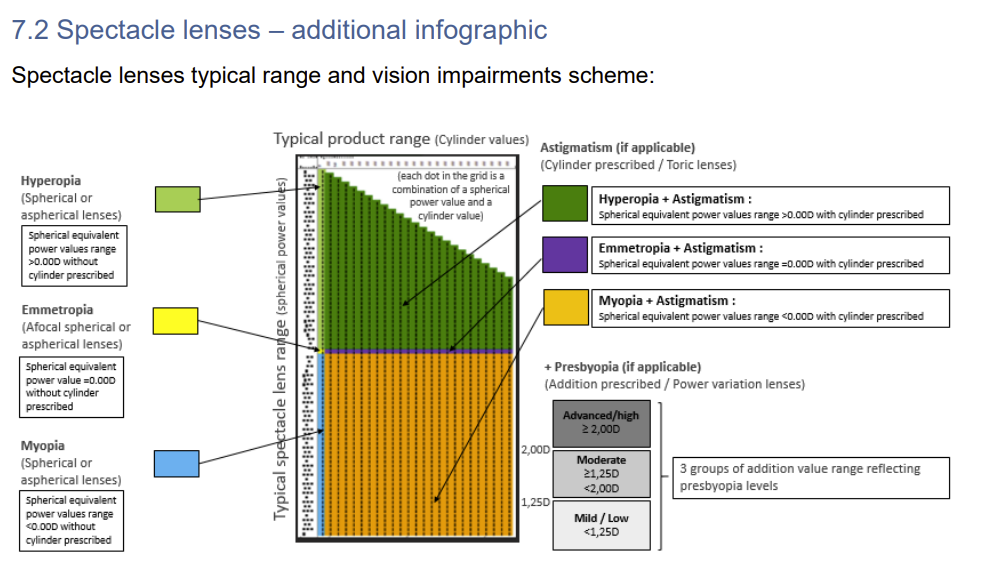
The now published Revision 1 is particularly relevant, even though it contains only selective adjustments in terms of content. The MDCG explicitly mentions two changes in the area of spectacle lenses: first, the designation “Advanced” was corrected to “Advanced/High” in a figure. Second, the threshold in the decision tree for Master UDI-DI assignment for this category was technically corrected: instead of “< 1.25 D”, Advanced/High now applies to “≥ 2.00 D”. This makes the classification of addition values for presbyopia clearer and more consistent.
In terms of content, the guidance makes it clear that the logic of the Master UDI-DI differs from classic UDI-DI assignment. While the Basic UDI-DI describes a group of products with the same intended purpose, the same risk class and the same essential design characteristics, the Master UDI-DI serves to further group highly individualized products on the basis of defined design parameters. For the affected product groups, the following also applies: Master UDI-DI and UDI-PI together form the UDI; the Master UDI-DI appears on the label and is also used in EUDAMED.
For spectacle frames, the guidance describes an assignment logic that initially relies on the Basic UDI-DI. This is based on the parameters frame construction and frame material. The Master UDI-DI is then additionally formed on the basis of the horizontal boxed lens width, typically in the range of 40 mm to 60 mm. Brand name or model reference are explicitly not Master UDI-DI triggers.
For spectacle lenses, the logic is significantly more complex. Here, the Basic UDI-DI is based on commercial indexes or material types as well as on the lens design. The Master UDI-DI is then determined on the basis of groups of the spherical equivalent, addition values and similar visual impairments. The guidance also explains the calculation of the spherical equivalent and classifies products according to values into groups such as myopia, hyperopia, astigmatism or presbyopia. In this area in particular, the now corrected distinction of the Advanced/High category is of practical relevance.
For ready-to-wear reading spectacles, the Basic UDI-DI is derived from the parameters frame construction, frame material and lens material. The Master UDI-DI supplements this with two additional design parameters: the horizontal boxed lens width and the spherical lens power, which is described in the guidance for the range of +1.00 D to +3.50 D. Here too, brands and catalogue numbers are not the actual assignment criteria for the Master UDI-DI.
The statements on packaging and vigilance are also important. Higher packaging levels may in principle require their own Master UDI-DI if they need to reflect the contents from a regulatory perspective. Typical shipping cartons with mixed contents, however, are generally regarded as logistical shipping containers and should normally not receive their own Master UDI-DI reflecting their contents. In a vigilance case, the guidance requires manufacturers to indicate the UDI composed of Master UDI-DI and UDI-PI and to be able to precisely narrow down the affected products additionally via internal traceability systems.
The timeline is also clearly stated once again: the Delegated Regulation was published in the Official Journal on 23.09.2025, entered into force on 13.10.2025 and will apply from 01.11.2028. According to the guidance, products manufactured before 1 November 2028 do not yet need to bear a Master UDI-DI on the label. For manufacturers, this means that operational preparation should begin early, even if mandatory application will only start later.
Conclusion:
MDCG 2025-8 Rev. 1 now provides concrete guidance for the implementation of the Master UDI-DI for spectacle frames, spectacle lenses and ready-to-wear reading spectacles. The revision itself does not introduce a new deadline or any fundamental system change, but it does clarify an important technical point in the classification of addition values for spectacle lenses. For manufacturers, the document is particularly relevant because it makes the practical logic of grouping, labelling and future EUDAMED registration much more tangible.
Please also read our news on the timeline for the introduction of the Master UDI-DI.









Related Posts