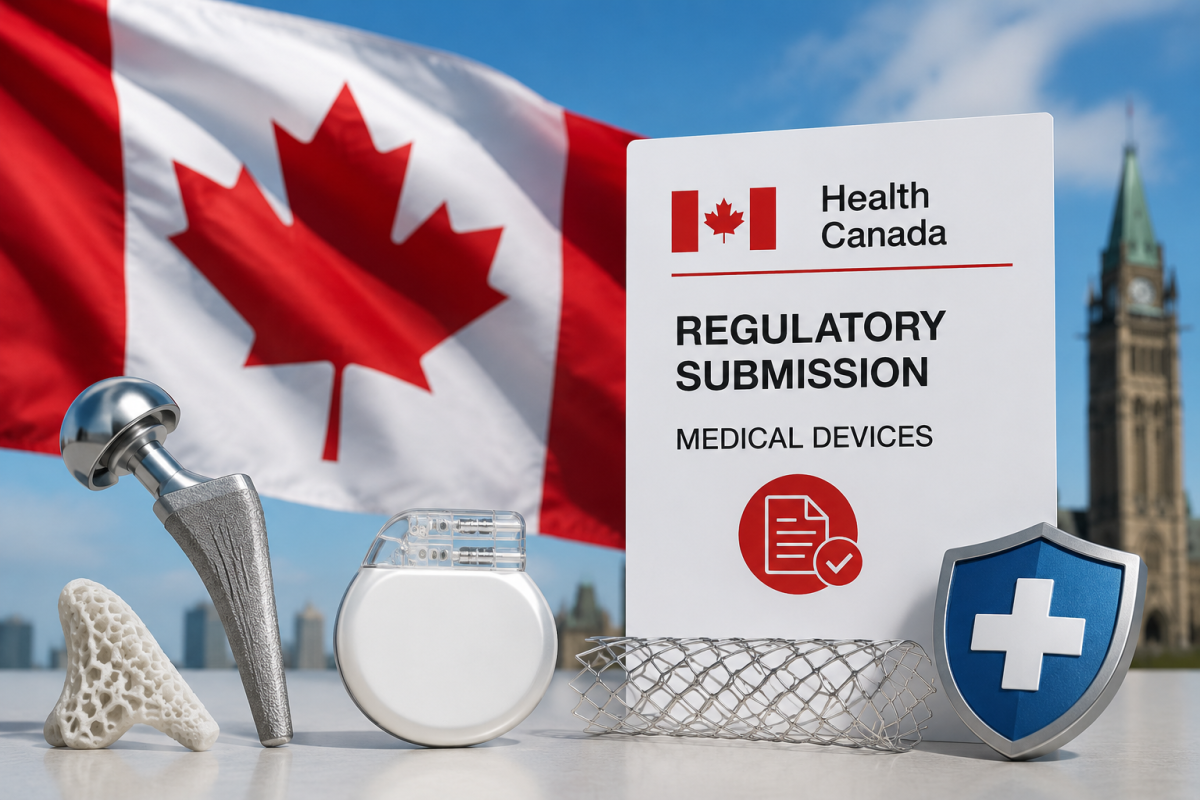
FDA ESG and Health Canada CESG:
how medical device submissions have been transmitted electronically since April 2026
Existing FDA Gateway accounts can generally also be used for submissions to Health Canada. However, transmission is carried out using separate Health Canada processes, XML structures and routing information. Direct forwarding of GUDID UDI data to Canada is therefore not possible.
Electronic submission mandatory since April 2026
Health Canada has further standardised the electronic transmission of certain medical device regulatory transactions. Since 1 April 2026, manufacturers have been required to use the Regulatory Enrolment Process, or REP, and the Common Electronic Submissions Gateway, or CESG, for the affected submission types.
Health Canada describes this change as part of the digital transformation of the Medical Devices Directorate. REP captures structured information relating to companies, dossiers, products, regulatory activities and individual transactions. Once completed, the web-based REP templates generate the corresponding XML files.
The REP XML files are submitted to Health Canada via CESG together with the relevant regulatory transaction. This also enables medical device submissions that are not provided in eCTD format to be transmitted electronically.
Which medical device submissions are affected?
The mandatory use of REP and CESG applies, among other things, to the following regulatory procedures:
- new medical device licence applications for Class II, III and IV devices,
- amendments to existing Class II, III and IV licences,
- Minor Change Amendments, also referred to as faxbacks,
- private-label licence applications and related amendments,
- responses to Terms and Conditions imposed by Health Canada,
- responses to requests from the authority for additional information,
- responses relating to the potential suspension of a medical device licence.
As a general rule, the regulatory documents must be structured in accordance with the IMDRF Table of Contents structure adopted by Health Canada.
However, REP currently does not apply to all medical device procedures. The following are among the processes not covered:
- Investigational Testing Applications,
- Medical Device Establishment Licence Applications,
- in particular, MDEL procedures for Class I devices,
- applications under the Special Access Program,
- certain medical devices governed by Part 1.1 of the Canadian Medical Devices Regulations.
Manufacturers must therefore first determine whether the specific regulatory activity falls within the current scope of REP.
What is the Common Electronic Submissions Gateway?
CESG serves as a secure electronic transmission channel between a company or trading partner and Health Canada.
From a technical perspective, it is closely connected to the FDA Electronic Submissions Gateway. According to Health Canada, a submitted regulatory transaction is initially received by the FDA portion of the gateway. It is then forwarded to the Health Canada portion of the gateway, where it is validated and imported.
During this process, the sender receives several technical acknowledgements:
- a Message Disposition Notification from the FDA Gateway,
- an FDA acknowledgement containing the Message ID and Core ID,
- a Health Canada acknowledgement confirming receipt by Health Canada.
Successful acceptance by the FDA Gateway does not automatically mean that the submission has also been successfully validated and imported by Health Canada. Manufacturers should therefore monitor the complete acknowledgement process and, in particular, document the Health Canada acknowledgement.
Which data structures does Health Canada use?
The Regulatory Enrolment Process uses several types of structured information and XML files. Depending on the process, these include:
- company information,
- dossier information,
- regulatory transaction data,
- application information,
- medical device information,
- regulatory activity and transaction information.
The corresponding web-based templates generate REP XML files. A regulatory transaction may, for example, contain the initial submission of a licence application, additional information requested by the authority or a response to a Health Canada enquiry.
In addition to the REP XML files, the actual regulatory documents must be compiled using the IMDRF Table of Contents structure specified by Health Canada. The requirements cover, among other things:
- folder structures,
- directory names,
- file formats,
- file names,
- maximum path lengths,
- technical document structure,
- permitted document properties.
Health Canada has published separate technical guidance adapted to the specific Canadian requirements.
Is there already a Canadian UDI database?
Health Canada has already examined the potential introduction of a Canadian UDI system. The official UDI consultation describes the feasibility of establishing a Canadian UDI database. The approaches considered included creating a separate database or using and extending existing Canadian infrastructure.
At the time of this consultation, the final Canadian UDI core data elements and the specific technical implementation had not yet been defined.
The current REP documentation for medical devices does not describe an operational transmission process for a Canadian UDI database. The REP process that is currently mandatory covers licence applications, licence amendments and other regulatory transactions. It does not cover the regular transmission of UDI master data to a Canadian UDI database comparable to GUDID or EUDAMED.
Canada’s existing Medical Devices Active Licence Listing, or MDALL, is also not equivalent to FDA GUDID. MDALL contains information on licensed Class II, III and IV medical devices. The term “Device Identifier” used in MDALL refers to a product identifier assigned by the manufacturer and does not automatically constitute a regulatory UDI-DI data record based on the GUDID model.
What does the change mean for manufacturers?
Manufacturers intending to obtain Canadian licences for Class II, III or IV medical devices or to amend existing licences should review their internal processes.
The following points are particularly relevant:
- Is the company already registered for REP?
- Is an up-to-date, final Company XML file available?
- Are the Company ID, Contact ID and, where applicable, dossier information available?
- Have the correct REP templates been used?
- Does the document package comply with Health Canada’s IMDRF Table of Contents structure?
- Is a CESG or FDA ESG trading partner account available?
- Has the correct Review Centre been selected for transmission?
- Are all technical acknowledgements and Health Canada acknowledgements monitored and archived?
Before submitting the actual licence application, new applicants must first provide the required company information through the Company process. Health Canada states that new applicants must submit a Company Template XML file before submitting a new medical device licence application.






Related Posts