
UDI registration in 2026: deadlines and implementation
For affected devices already placed on the market, the EUDAMED transition deadline expires on 28 November 2026; in Switzerland, the general swissdamed transition period ends on 31 December 2026. What manufacturers, authorised representatives and UDI teams need to know about deadlines, responsibilities and technical submission methods.
Two markets, different deadlines and no direct authority-to-authority synchronisation: UDI registration in 2026 requires medical device and IVD manufacturers to do more than upload data once. Accurate product data, clear responsibilities, a suitable submission route and verification of actual registration results are essential.
These requirements affect Regulatory Affairs as well as Quality Management, product data management, IT and Sales. If data is gathered only shortly before a deadline, missing economic-operator links, incomplete UDI records or technical import errors may delay compliance. A structured approach helps identify regulatory and technical risks at an early stage.
Which EUDAMED and swissdamed deadlines apply in 2026?
Since 28 May 2026, use of the first four EUDAMED modules has been mandatory, including the UDI/Device Registration module. For new devices subject to the registration obligation applicable since that date, registration must generally be completed before the first unit is placed on the EU market.
A transitional arrangement applies to certain devices where units had already been placed on the market before 28 May 2026 and further units will continue to be placed on the EU market. For these cases, the registration deadline is 28 November 2026. Whether an individual device falls within this provision depends, among other factors, on its regulatory status and the date of placing on the market. The distinction between Regulation Devices and Legacy Devices remains relevant.
In Switzerland, registration of relevant medical devices, in vitro diagnostics, systems and procedure packs in swissdamed has been mandatory since 1 July 2026. The general transition period ends on 31 December 2026. Certain vigilance cases trigger an immediate registration requirement before that date. Special cases must therefore be assessed separately.
| Aspect | EUDAMED (EU) | swissdamed (Switzerland) |
|---|---|---|
| Mandatory use | UDI/Device module since 28 May 2026 | Device registration since 1 July 2026 |
| Key transition deadline | 28 November 2026 for certain existing devices | 31 December 2026 as the general transition deadline |
| Registering party | Generally the manufacturer | Swiss manufacturers, system/procedure-pack producers and authorised representatives for devices covered by their mandates |
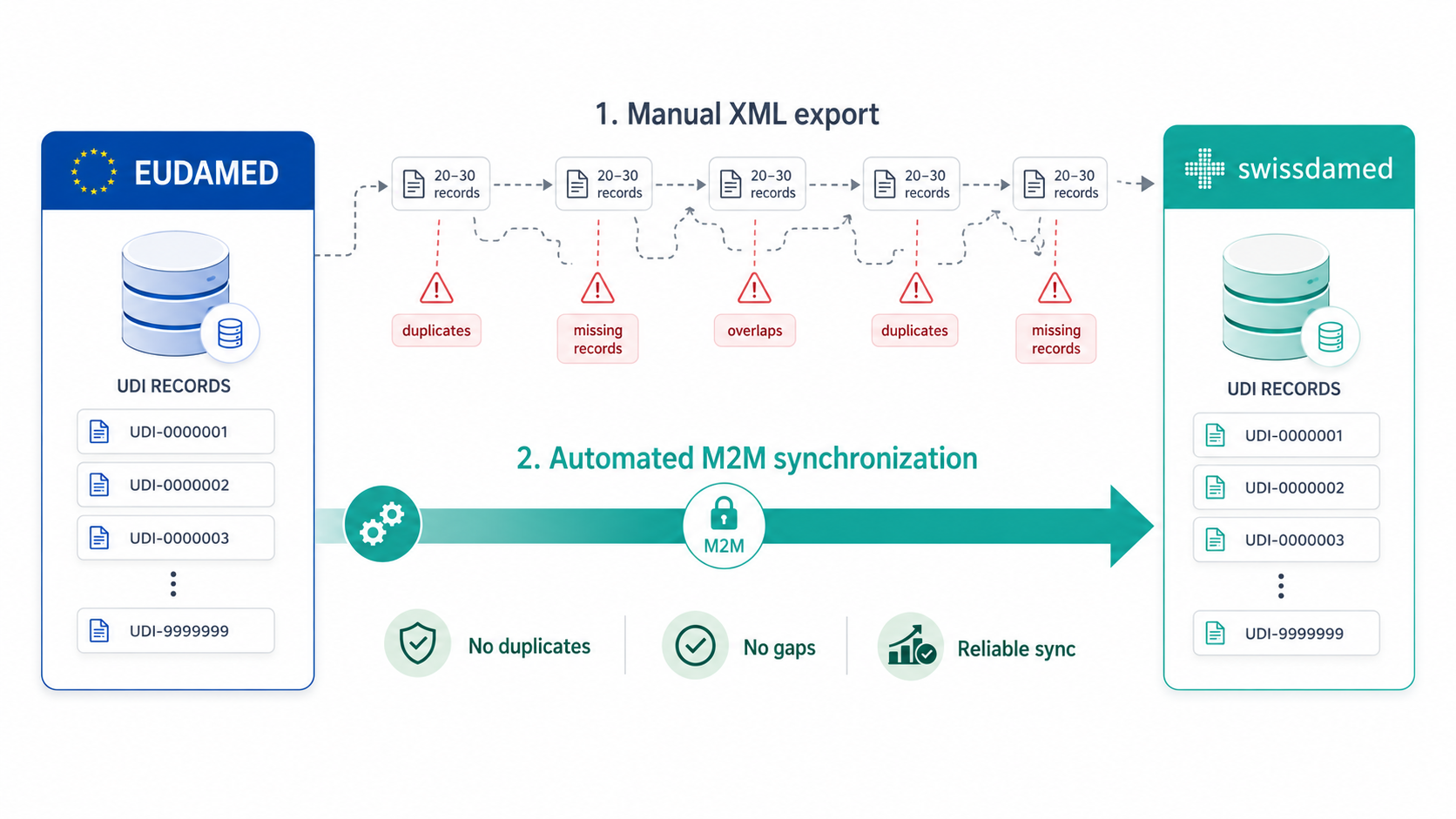
| Data submission | Manual entry, structured data exchange and M2M, depending on the procedure | Online editor, XML upload or M2M via REST/JSON |
| Automatic transfer from the EU database | — | No: a separate submission to swissdamed is required |
This overview simplifies the legal requirements. Device class, MDR/IVDR status, economic-operator role and special provisions must be assessed case by case. Further reading: Missing an EUDAMED deadline: possible consequences.
Who is responsible for device registration?
In the EU, the manufacturer is generally responsible for device registration. This must be distinguished from economic-operator registration and from regulatory or technical assistance provided by third parties. A service provider may prepare and submit data, but this does not automatically transfer the legal responsibility of the obligated economic operator.
For swissdamed, Swissmedic identifies in particular Swiss manufacturers, persons assembling systems and procedure packs, and Swiss authorised representatives for devices covered by their mandates. Relevant economic-operator registrations and mandate relationships must be in place to submit records correctly.
Importers do not register products themselves in swissdamed. Instead, they link their economic-operator registration to the relevant UDI-DIs of products already registered with the status “On the market”. Swissmedic provides a transition period for this technical linking requirement until 1 April 2027.
These tasks should be planned separately: Who creates the product data? Who reviews it from a regulatory perspective? Who controls the authority accounts? Who approves the records? And who checks that the intended final status has actually been reached?
Why EUDAMED data does not automatically appear in swissdamed
swissdamed is based on a data model aligned with EUDAMED. UDI information already prepared for the EU can therefore often serve as a starting point for the Swiss market. Nevertheless, the platforms are technically and organisationally independent.
Swissmedic does not operate a direct authority-to-authority interface that automatically imports or synchronises product data from EUDAMED. Information must be actively submitted to swissdamed and must meet Swiss business rules. Similar-looking fields do not remove the need to verify economic-operator relationships, validations and final statuses separately.
Companies can maintain a central internal data repository and use appropriate software to prepare submissions to different authorities. This internal reuse of data should not be confused with automatic synchronisation between the authorities' own platforms.
Online editor, XML or machine-to-machine: which route makes sense?
The appropriate submission method depends on more than the number of devices. The frequency of changes, quality of source data, available IT expertise, internal approvals and preferred operating model also matter.
| Method | Suitable when … | Key consideration |
|---|---|---|
| Online editor | a small number of records must be entered or corrected manually | Time required, consistency and four-eyes review |
| XML upload | structured data is available and file-based imports are preferred | Target-system schema, business rules and results |
| Machine-to-machine (M2M) | recurring submissions, larger portfolios or integrated workflows are required | Technical onboarding, access rights, mapping and error feedback |
For swissdamed, Swissmedic specifies the online editor, manual XML upload using the EUDAMED “GET DEVICE” or “POST DEVICE” format, and M2M submission via a REST API using JSON. For manual XML uploads, a Basic UDI-DI and a UDI-DI must be transmitted as a 1:1 pair, with a maximum of 300 such pairs per file. The M2M API also processes one Basic UDI-DI and one UDI-DI per POST request.
An XML file accepted by EUDAMED will not necessarily be accepted by the Swiss system. Pre-validation against the latest requirements of each authority is therefore essential.
Five checks before UDI device registration
- Segment the portfolio and its deadlines
Classify devices by market (EU/Switzerland), MDR/IVDR or legacy status, placing-on-the-market date and planned future units. Assess vigilance and other special cases separately.
- Verify responsibilities and access
Assign manufacturers, authorised representatives, mandates, economic-operator identifiers, internal approvals and technical access for each target system. Plan Swiss importer links as a separate activity.
- Validate UDI data from a regulatory perspective
Check the correct allocation of identifiers, required fields and classifications; resolve contradictory or duplicate information. Different identification rules can apply to Legacy Devices.
- Select the submission route and a test dataset
Begin with a controlled subset, resolve schema and business-rule errors, and only then plan the processing of larger data volumes.
- Track the actual registration results
Document authority feedback at record level, correct errors in the source, resubmit where required and organise subsequent changes after initial registration.
What are the possible consequences of missing a registration?
If a mandatory EUDAMED registration is missing for affected device units, further placing of those units on the EU market may not be lawful. In this context, placing on the market generally means making an individual device unit available on the EU market for the first time—not every subsequent resale within the supply chain.
Consequently, a missing database entry does not automatically require the immediate recall of every unit previously placed on the market lawfully, nor does it trigger a single standard EU fine immediately. The consequences depend on the specific breach, the applicable national rules and the individual circumstances. Manufacturers that have missed a deadline should prioritise outstanding registrations and document their legal and regulatory assessment.
From a successful upload to a verifiable result
A submitted file is not the same as a completed registration.
Electronic submissions involve separate stages: technical acceptance, validation, processing and final record status. A generic “upload successful” message may hide individual devices that have not been fully processed due to regulatory or technical errors.
A robust process therefore includes structured evaluation of authority responses, clear ownership of corrections and an auditable history of submissions and status changes. This traceability remains important when the same internal UDI data is used for multiple countries or authorities.
Frequently asked questions about registration
Does EUDAMED registration automatically cover the Swiss market?
No. Swissmedic expressly confirms that there is no direct authority-to-authority import or synchronisation between EUDAMED and swissdamed. Existing EUDAMED data may serve as a source, but registration in swissdamed requires a separate submission.
Must every device previously sold be registered in EUDAMED by 28 November 2026?
No. That would be an overly broad statement. What matters is whether the specific device is subject to a registration obligation and whether further units are to be placed on the market. Units already lawfully placed on the market and legacy cases require separate consideration.
Does a Swiss importer register the UDI data?
Generally no. The importer links its economic-operator registration with the relevant UDI-DIs after a responsible party has registered the device. Swissmedic identifies 1 April 2027 as the end of the transition period for this linking requirement.
When is M2M preferable to XML upload?
M2M may be advantageous when data is submitted regularly and changes need to be processed systematically. XML may be suitable for one-off or smaller projects. The choice depends on source data, volume, frequency of changes and technical onboarding.
How Europe IT Consulting supports EUDAMED and swissdamed
Europe IT Consulting GmbH, based in Basel, supports medical device and IVD companies with UDI data preparation, data validation and electronic regulatory submissions. The Global Submission Portal (GSP) enables structured source data to be prepared, checked, approved, submitted and tracked in a controlled workflow for different regulatory target systems. Additional UDI integration solutions are available for SAP environments.
At project initiation, the device portfolio, current registration status, data sources, target markets, existing authority accounts and customer-side approvers should be clarified. These inputs determine whether manual upload, a structured one-off project or a recurring submission process is the most suitable option.
Preparing UDI registration for EUDAMED or swissdamed?
We can review your existing data, target systems and suitable submission route with you—from a one-off XML submission to a controlled M2M process.
Official sources and regulatory review date
Regulatory information reviewed on 19 November 2026. Authority guidance may change; the applicable legislation and device-specific requirements remain decisive.
- European Commission: EUDAMED UDI/Device Registration
- European Commission: EUDAMED – Getting ready
- BfArM: EUDAMED registration and deadlines (German)
- Swissmedic: Device registration in swissdamed (German)
- Swissmedic: Device registration and technical submission FAQ (German)
- Swissmedic: Importer responsibilities and linking deadline (German)
This article provides general information, not legal advice. It does not replace an assessment of the relevant device and economic-operator circumstances.








Related Posts