
swissdamed Deadlines and Registration Fees:
Key Clarifications from Swissmedic
Do manufacturers have to pay again every year for the same UDI-DI? Does it matter whether a product was registered before or after 1 July 2026? Does the transition period also apply to new products placed on the market for the first time after this date? And does the registration requirement apply from 1 July or only from 31 December 2026?
We have received numerous questions on these points. We therefore contacted Swissmedic directly for clarification. Its response provides clarity, particularly with regard to the annual calculation of fees.
The most important answer first
A UDI-DI that has already been charged will not be invoiced again every year.
However, a special cut-off date rule applies to the initial calculation of fees:
- All UDI-DIs with the status “On the market” in swissdamed on 31 December 2026 will be taken into account.
- It does not matter whether the UDI-DI was registered during the voluntary phase, before 1 July 2026 or only after that date.
- From 1 January 2027, only newly registered UDI-DIs will be charged.
- Updates to UDI-DIs that have already been registered are free of charge.
The registration deadline and the calculation of fees are therefore connected, but they are not the same.
Which deadlines apply to swissdamed?
| Date | Significance |
|---|---|
| 18 August 2025 | Start of voluntary product registration in the UDI Devices module |
| 1 July 2026 | Entry into force of the registration requirement; start of the transition period |
| 31 December 2026 | End of the general transition period and cut-off date for the first calculation of fees |
| From January 2027 | First invoices issued for UDI-DIs registered with the status “On the market” on 31 December 2026 |
| From 1 January 2027 | Regular invoicing exclusively for newly registered UDI-DIs |
The registration requirement has applied since 1 July 2026. The products, systems and procedure packs concerned are generally subject to a transition period until 31 December 2026.
An important exception applies to vigilance cases: if a serious incident, field safety corrective action (FSCA) or trend involving a product must be reported to Swissmedic, the product concerned must be registered in swissdamed immediately as of 1 July 2026. The general transition period does not apply in these cases.
Important: The transition period also applies to new products
When interpreting the deadlines, swissdamed should not be treated as identical to EUDAMED. There is an important difference, particularly for products placed on the market for the first time after the respective cut-off date.
The EUDAMED rules
The following has applied to the EUDAMED UDI/Devices module since 28 May 2026:
- If the first unit of a UDI-DI was already placed on the EU market before 28 May 2026 and further units are placed on the market after that date, the transition period may be used for registration.
- If the first unit of a new UDI-DI is placed on the market on or after 28 May 2026, the UDI-DI must generally be registered in EUDAMED before that first unit is placed on the market.
New products in EUDAMED therefore do not benefit from the same transition period as products that were already marketed before the cut-off date.
The swissdamed rules
A different transition approach applies to swissdamed. The decisive factor is whether individual units of a product are placed on the Swiss market from 1 July 2026 onwards.
The transition period until 31 December 2026 generally applies in both of the following cases:
- Products already marketed before 1 July 2026:
If units bearing a UDI-DI were already placed on the market before the cut-off date and further units bearing the same UDI-DI are placed on the market after 1 July 2026, the UDI-DI must be registered by 31 December 2026 at the latest. - New products from 1 July 2026:
If the first unit of a new UDI-DI is placed on the market on or after 1 July 2026, the transition or tolerance period until 31 December 2026 may generally also be used for this registration.
Although the general rule requires registration before placing a product on the market, the special transitional provision expressly grants a deadline until 31 December 2026 for the introductory phase. From 1 January 2027, registration must take place before the product is placed on the market in accordance with the regular rules.
The difference at a glance
| Scenario | EUDAMED | swissdamed |
|---|---|---|
| First unit placed on the market before the registration requirement begins, with further units placed on the market afterwards | Transition period for registration | Transition period until 31 December 2026 |
| First unit of a new product placed on the market after the registration requirement begins | Registration before the first unit is placed on the market | Transition period until 31 December 2026 may generally be used |
| No further unit placed on the market after the registration requirement begins | Generally, no regular retrospective registration required | No registration required solely with retrospective effect |
What exactly does “already on the market” mean?
From a legal perspective, placing on the market relates to each individual unit. To determine whether registration is required, it is therefore not sufficient merely to ask whether a product model was available in Switzerland at any time before 1 July 2026.
The decisive points are:
- Are further units bearing this UDI-DI placed on the market on or after 1 July 2026? If so, the UDI-DI must be registered in swissdamed.
- Were all units already placed on the market before 1 July 2026, with no further units placed on the market after that date? If so, there is generally no registration requirement solely with retrospective effect.
- If a serious incident, an FSCA or a trend must be reported, immediate registration may nevertheless be required.
The transition period is therefore not a postponement of the registration requirement for certain legacy products. Instead, it provides additional time for all UDI-DIs that are regularly subject to registration—including new products—where units are placed on the market from 1 July 2026 onwards.
Three practical examples
- Product A has been distributed in Switzerland since 2024. Further units bearing the same UDI-DI are placed on the market in September 2026. The UDI-DI must be registered in swissdamed by 31 December 2026 at the latest.
- Product B is placed on the Swiss market for the first time in October 2026. This new product may also generally make use of the transition period and must be registered by 31 December 2026 at the latest.
- Product C is placed on the Swiss market for the first time in January 2027. The transition period has ended. The UDI-DI must be registered before the first unit is placed on the market.
If a reportable vigilance case involving Product A or B occurs before registration, the product must be registered immediately. In such a case, registration cannot be postponed until 31 December 2026.
Which products will be included in the first invoice?
For the first invoice, the original registration date is not decisive. What matters is the status on 31 December 2026.
All UDI-DIs with the status “On the market” on this cut-off date will be charged. This also applies to products that were registered voluntarily in swissdamed before the registration fees entered into force.
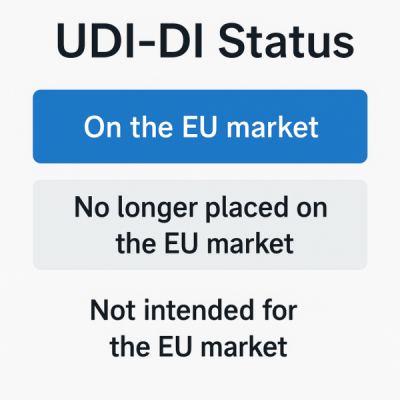
No fee is charged if a UDI-DI is correctly marked with the status “No longer placed on the market” on 31 December 2026. The stated status must, of course, reflect the actual marketing situation.
Will the same UDI-DI be charged again every year?
No.
Swissmedic has confirmed that the registration fee for each UDI-DI is generally charged only once. UDI-DIs that have already been charged will not be invoiced again in subsequent calendar years.
From 2027, the following applies:
- If no new UDI-DI is registered during a calendar year, no new product registration fee will be charged for the existing portfolio.
- If at least one new UDI-DI is registered, a new calculation cycle begins for the new registrations made during that calendar year.
- Existing UDI-DIs that have already been charged will not be counted again.
The wording “first product per year” therefore does not mean that a basic fee is charged again each year for every existing product portfolio. The basic fee is triggered only if at least one new UDI-DI is registered in the calendar year concerned.
How much are the registration fees?
The fees are calculated per manufacturer or per person who assembles systems or procedure packs:
- CHF 200 for the first UDI-DI in a calendar year
- CHF 20 for each additional UDI-DI in the same calendar year
- a maximum of CHF 10,000 per calendar year
The CHF 10,000 cap is reached at 491 chargeable UDI-DIs:
1 × CHF 200 + 490 × CHF 20 = CHF 10,000
From the 492nd UDI-DI onwards, no additional fees are incurred in the same calendar year.
Specific calculation examples
| Example | Calculation | Fee |
|---|---|---|
| 1 UDI-DI has the status “On the market” on 31 December 2026 | 1 × CHF 200 | CHF 200 |
| 100 UDI-DIs have the status “On the market” on 31 December 2026 | CHF 200 + 99 × CHF 20 | CHF 2,180 |
| The same 100 UDI-DIs remain registered in 2027; no new UDI-DI is added | No repeat charge | CHF 0 |
| Five new UDI-DIs are added to the existing 100 UDI-DIs in 2027 | CHF 200 + 4 × CHF 20 | CHF 280 |
| Data for an existing UDI-DI is corrected or updated | Update without new registration | CHF 0 |
If a UDI-DI was previously marked as “discarded” and the product is subsequently registered again, a registration fee will be charged again for this new registration.
Are fees calculated per manufacturer or per CH-REP?
The fees are generally assigned to the respective manufacturer or the person who assembles systems or procedure packs—not to the entire portfolio of a CH-REP.
- Swiss manufacturers receive the invoice directly.
- For foreign manufacturers, the invoice is addressed to the responsible CH-REP in Switzerland or Liechtenstein.
- For foreign manufacturers without an SRN, Swissmedic calculates the fees per mandate.
A CH-REP representing several manufacturers therefore does not receive one shared fee cap covering all mandates. The annual cap applies separately at the level of each individual manufacturer or system/procedure pack producer.
What should companies review now?
- Determine the scope of registration: Which products, systems and procedure packs will continue to be placed on the market in Switzerland or in the common Switzerland/Liechtenstein market after 1 July 2026?
- Prioritise products involved in vigilance cases: The transition period does not apply to reportable products.
- Review UDI data and status: The status on 31 December 2026 is particularly important for the first calculation of fees.
- Choose a registration method: Depending on the volume of data, the available options are the online editor, XML upload or machine-to-machine communication via the REST API.
- Clarify responsibilities: CHRN details, mandates, user permissions and coordination between the manufacturer and CH-REP should be reviewed in good time.
Conclusion
The most common uncertainties can therefore be answered clearly:
- There is no annually recurring registration fee for the same UDI-DI.
- The general swissdamed transition period until 31 December 2026 applies in principle both to products already being marketed where further units are placed on the market after 1 July and to new products placed on the market for the first time after 1 July 2026.
However, the first invoice will include all UDI-DIs with the status “On the market” on 31 December 2026, irrespective of their original registration date. From 2027 onwards, only newly registered UDI-DIs will be charged; updates to existing entries will remain free of charge.
Europe IT Consulting supports manufacturers and CH-REPs in the structured preparation, validation and transmission of their UDI data to swissdamed—via XML, machine-to-machine communication, the Global Submission Portal or an SAP-integrated solution.
Official sources and further information
Swissmedic
- Product registration in swissdamed
- Registration fee
- Information sheet “Medical device registration fee”
- Questions and answers about swissdamed
- FOPH: Explanatory report on product registration
European Commission
Further articles from Europe IT Consulting
- swissdamed registration fees
- Mandatory registration in swissdamed from July 2026
- swissdamed: Medical device registration now available
Last updated: 28 July 2026. The current information and legal bases published by Swissmedic shall prevail.








Related Posts