EUROPE IT · UDI KNOWLEDGE AND SOLUTIONS
Europe IT Consulting GmbH, based in Basel, develops software and supports medical device and IVD companies with UDI data management, data validation and regulatory submissions. This knowledge center connects the requirements of EUDAMED, swissdamed, FDA GUDID and TGA AusUDID with the relevant products and services. FDA eMDR and European MIR reporting are addressed as separate reporting processes.
The Global Submission Portal (GSP) provides a web-based submission workflow without requiring SAP. The Global UDI SAP Add-on (GUDI) integrates UDI processes into SAP. The UDI Excel Cloud Validator provides preliminary checks of supported Excel data. Europe IT also offers UDI submission services and data preparation, together with SAP integration and software development.
This resource is intended for Regulatory Affairs, quality management, product data and IT teams, as well as purchasing and management. It explains which data belong in which system, who is responsible and how to establish a traceable process from the source data to the authority’s response. The UDI Guide explains the fundamentals; this knowledge center brings authorities, products, services and practical scenarios together in a comprehensive overview.
Information reviewed as of: . Regulatory information must be applied in the context of the particular device, market and economic operator. Applicable legislation determines legal obligations; current product documentation and the agreed scope of services determine product functionality.
Europe IT Consulting: company and expertise
Company: Europe IT Consulting GmbH. Registered office: Steinentorstrasse 35, 4051 Basel, Switzerland. Activities: Software development, SAP consulting, UDI data management and electronic regulatory data transmission for medical devices and IVDs. Company profile · Contact.
Europe IT connects several tasks that medical device manufacturers often manage in separate organizational units: product master data, UDI identifiers, preparation of regulatory datasets, technical validation, approval, submission, response handling and ongoing data maintenance. The available solutions are not interchangeable: GSP is a web-based portal, GUDI is an SAP-related add-on and the Excel Cloud Validator is a preliminary validation solution. Project-specific data and software services complement these products.
Company development: Europe IT Consulting describes its establishment in 2011 and its long-standing work on SAP and UDI solutions in its company profile. The customer reference overview and published case studies illustrate publicly documented project areas.
Guiding question: Which data must go where, in which format, under whose responsibility and with what evidence? Europe IT addresses this through software products and accompanying services; the respective economic operator remains responsible for medical and regulatory decisions.
What role does Europe IT play in the overall registration process?
In practice, regulatory data transmission rarely begins with the interface. A manufacturer must first know which devices and identifiers are relevant to a market, who approves the data and which systems provide them. Only then can the information to be transmitted to each authority be determined. Europe IT operates at this intersection of Regulatory Affairs, product master data and information technology. The aim is to map the path from source information through validation to a traceable submission.
Three central types of service must be distinguished: A software license enables a defined process within the customer’s own organization. Project or consulting services support its regulatory and technical implementation. A submission service performs agreed operational tasks without removing the manufacturer’s statutory obligations. The appropriate option depends on the size of the dataset, the authorities involved, the existing ERP system and the frequency of subsequent changes.
The scope covers data preparation, data quality, SAP integration, international submission processes, error handling and the associated evidence. The product overview links to the individual solutions; a quotation defines the modules, transmission methods and project scope.
Target groups and project tasks
Target groups: Medical device and IVD manufacturers, legal manufacturers, Regulatory Affairs, Quality Assurance, UDI/master data teams, SAP/ERP managers, IT system integrators and service providers appointed for specific activities. Depending on the country, authorized representatives, importers and other economic operators also participate in registration processes; they do not automatically have the same statutory duties as the manufacturer.
Typical starting points: Small or very large product portfolios; a one-time initial submission; large-scale migration of existing data; recurring changes; heterogeneous data repositories; SAP as the leading data source; Excel-based master data; different national requirements; insufficient visibility of errors; stringent requirements for approvals, audit evidence and documentation.
Project tasks: Capture and clean product data, map fields to each authority’s data model, check identifiers and packaging relationships, organize approvals, carry out submissions and process responses. These tasks can be performed internally using software, jointly with Europe IT or through an agreed submission service.
Who is looking for which information?
Regulatory Affairs staff primarily ask about registration obligations, data elements, deadlines, permissible corrections and the regulatory status of a submission. Master data teams focus on field definitions, identifiers, data mapping and consistency across source files. IT managers assess interfaces, authentication, data volumes, the operating model and integration with existing ERP systems. Quality management and auditors need verifiable approvals, change information and authority responses.
Management and purchasing instead need to decide between in-house operation and external support. The number of devices to register is not a sufficient decision criterion on its own: a small portfolio with many variants and complex packaging levels can require more effort than a large, well-structured product catalog. Conversely, a one-time registration without subsequent changes may justify a different operating model from an ongoing international portfolio.
This resource is therefore organized by regulatory target system, typical task and appropriate service model. A manufacturer’s question should lead beyond a definition to the relevant further explanation in the UDI Guide or suitable service.
Authorities and regulatory target systems
| Market | Official target system | Purpose | Distinction / Europe IT connection |
|---|---|---|---|
| European Union | EUDAMED | Economic operator and medical device information, plus further EU modules | Europe IT: UDI data management, EUDAMED submissions and regulatory data preparation |
| Switzerland | swissdamed | Registration of economic operators and the medical devices/IVDs concerned | Europe IT: Swiss-specific data preparation and submission workflow |
| USA | FDA GUDID | Device identification data under the FDA UDI system | Europe IT: GUDID data preparation, templates and submission workflow |
| Australia | TGA AusUDID | UDI-DIs and associated product data under Australian law | Europe IT: AusUDID preparation and corresponding software workflows |
| USA | FDA eMDR | Electronic reporting of certain medical device adverse events | Not UDI device registration; a separate reporting process |
| EU | EUDAMED Vigilance / MIR | Incident reporting and vigilance processes | Not UDI device registration; technical availability must be confirmed separately |
Shared data do not mean identical data models. Before reusing data across countries, field mappings, identifier logic, national mandatory information, responsibilities, access rights and permitted transmission formats must be checked.
UDI data submission · UDI worldwide: market overview.
Why authorities must not be treated as interchangeable recipients
A registration platform can serve different target systems, but each remains a distinct regulatory environment. The European Union uses MDR/IVDR and EUDAMED; Switzerland applies its national medical device legislation and swissdamed; the USA uses the FDA UDI system and GUDID; and Australia applies TGA requirements. Their technical data models and registration obligations are not identical.
Before cross-border data transmission, document for each target system: Which economic operator has the legal obligation? Which product categories and risk classes are affected? Which identifiers are required? Which datasets may be derived from existing submissions? Which procedures does the authority support for submission and correction? How is successful registration evidenced?
The European Commission, Swissmedic, FDA and TGA publish the applicable requirements. Comparisons should rely on these primary sources rather than on a blanket assumption that an existing dataset will be accepted unchanged everywhere.
UDI fundamentals and terminology
Looking for a particular term? Go directly to the integrated A–Z glossary.
Unique Device Identification (UDI): A system for uniquely identifying medical devices. It comprises identifier assignment rules, data structures, labeling requirements and, where applicable, database registration. UDI is neither simply a barcode nor evidence that a submission to an authority has already taken place.
UDI-DI / Device Identifier: The device-related identifier specified by the system concerned. UDI-PI / Production Identifier: Variable production-related information, such as lot number, serial number, manufacturing date or expiry date, where relevant. Basic UDI-DI: The fundamental European device model identifier under MDR/IVDR, which must not be confused with the specific UDI-DI of an individual packaging level.
Primary DI: A context-dependent identifier, particularly relevant in certain non-EU data models; it must not generally be equated with the European Basic UDI-DI. Issuing Entity / Issuing Agency: An authorized identifier issuing organization, such as GS1 or HIBCC; the assignment rules applicable to the particular case must be followed. GTIN: GS1 Global Trade Item Number; depending on the system, it can serve as the basis of a UDI-DI. HIBC: Health Industry Bar Code structure.
UDI carrier: The representation of a UDI in machine-readable form (AIDC) and, in principle, as a human-readable interpretation (HRI), subject to the rules and exemptions applicable to the device. An AIDC symbol may, for example, be a GS1 DataMatrix. HRI: Human Readable Interpretation, a human-readable character sequence. AIDC: Automatic Identification and Data Capture. Packaging hierarchy: UDI relationships between different packaging levels. Unit of Use: An identification concept for certain use situations; it must not be confused with the UDI-DI directly applied to each individual package.
EMDN: European Medical Device Nomenclature. SRN: Single Registration Number, an EUDAMED registration number for certain economic operators. CHRN: Swiss registration number for certain economic operators, distinct from the EU SRN. Actor Registration: Registration of an economic operator. Device Registration: Registration of a device. Legacy device: A device covered by the applicable European transitional provisions. DMIDS: The German Medical Devices Information and Database System; the transition to EUDAMED depends on the data area and applicable requirements.
XML / XSD: Extensible Markup Language / schema description for validating structure or format. JSON: A structured data interchange format, for example for REST interfaces. REST API: A programmatic web interface. M2M: Machine-to-machine data exchange. Bulk upload: Transmission of multiple records together. Data mapping: Assigning source information to authority-defined fields. Validation: Checking defined rules; it does not prove the regulatory correctness of all information. Submission: Actual submission to an authority. Acknowledgment / feedback: A technical or substantive response. Audit trail: A traceable history of activities and changes. CAPA: Corrective and Preventive Action.
Europe IT terminology · UDI barcodes and labeling.
An example of identifiers and data levels
A manufacturer may market several variants of a medical device. At European level, related devices may be grouped under a Basic UDI-DI. Separate UDI-DIs are maintained for specific device and packaging configurations where the relevant assignment rules require them. Production-related information, such as a lot or serial number, belongs to the UDI-PI. The label carries an appropriate UDI carrier, while EUDAMED processes the required master data. These levels are connected but are not identical.
Typical data error: An identifier used on the label is reused in the master data list for all package sizes even though the assignment rules require different identifiers. Another error occurs when a European Basic UDI-DI is entered in a US GUDID field that expects a different type of Device Identifier. Both situations can produce substantive inconsistencies even when the data formally conform to an allowed character format.
The technical details depend on the authorized issuing entity and the market. The European UDI requirements and FDA UDI information provide overarching guidance. Identifier assignment itself must be distinguished from subsequent submission to the authority.
Terminology used in projects
A term’s meaning depends on the target system and process step. Clear definitions help describe the scope of services and technical implementation unambiguously.
| Term | Meaning and distinction |
|---|---|
| Submission | Transmission to the relevant target system. Data preparation and acceptance by the authority are separate steps. |
| Device Registration | Recording a device dataset required by regulation. This is distinct from registering an economic operator. |
| Data Mapping | Assigning a source value to an authority-defined field. Translating the field name alone is insufficient. |
| Bulk Upload | File-based import of multiple records using a supported procedure; this is not automatically an M2M connection. |
| Machine-to-Machine / M2M | Programmatic data exchange between systems. Format, access and status model depend on the authority. |
| Validation | Checking defined rules. An automated data check replaces neither substantive approval nor an authority response. |
| UDI Data Management | Managing identifiers, product data, relationships and changes throughout the lifecycle. |
| Vigilance | Assessing and reporting relevant incidents; separate from ongoing device master data registration. |
EUDAMED: modules, actors and device registration
EUDAMED is the European database on medical devices under MDR and IVDR. Its six functional areas are Actor Registration, UDI/Device Registration, Notified Bodies & Certificates, Clinical Investigations & Performance Studies, Vigilance & Post-Market Surveillance, and Market Surveillance. According to the European Commission’s notice, use of the first four modules declared functional (Actors, UDI/Devices, Notified Bodies & Certificates, and Market Surveillance) has been mandatory since 28 May 2026; the other areas have separate transition arrangements. It is essential to distinguish a module’s existence, its technical availability and mandatory use under the law.
Depending on device group, class and legal situation, EUDAMED registration requires data on the manufacturer/actor, Basic UDI-DI or legacy identifier, UDI-DI, device description, risk class, EMDN, certificate references and specific characteristics. The exact mandatory-field schema depends on MDR/IVDR, the data model version and the type of case. A universal list identical for every device would be misleading.
Process: Establish responsibilities → register the actor where required → assign product family/Basic UDI-DI and individual devices → check fields and packaging relationships → review and approve the dataset → submit manually or electronically → assess responses → maintain data. Permitted transmission methods and technical formats are determined by the current EUDAMED documentation.
EUDAMED resources: Europe IT EUDAMED overview · EUDAMED database structure · EUDAMED FAQ · EUDAMED error library · EUDAMED M2M · European Commission: EUDAMED · EU UDI/Devices.
What must be clarified before the first EUDAMED record
Creating a device record is only one of several steps. Manufacturers should first check their legal role and actor registration. For the device, the applicable legal framework, risk class, relevant UDI identifiers and any certificate links matter. It must also be clear who within the company grants substantive approval and who may initiate technical submissions.
A second step is analyzing product families and variants. One Basic UDI-DI may correspond to several UDI-DI records. Packaging variants and changes in device characteristics can create further relationships. Discovering these only during upload causes avoidable correction cycles. Relationships in the source system should therefore be checked before transmission.
To demonstrate success, companies should distinguish internally approved data, technically transmitted data, data received by the system and data finally registered or processed. The European Commission’s official UDI/Device documentation is the authoritative source for the applicable procedure. A short EUDAMED introduction can help users get started but does not replace an assessment of the individual case.
What role does EUDAMED play in the regulatory ecosystem?
EUDAMED is not a single upload form but a group of electronic systems for European medical device regulation. The distinction matters because responsibilities depend on the activity as well as the device: a manufacturer creates a device record, an economic operator needs the appropriate registration and authorization, a notified body manages its certificate information, and competent authorities handle different market surveillance information. The European Commission describes the modules and their status in its EUDAMED overview. The legal foundations are set out in the MDR and IVDR.
Actor Registration: This concerns the registration and identification of certain economic operators. It is insufficient for a company to be known elsewhere within an authority’s systems. Before submission, check whether the relevant actor has been created, validated and authorized for the intended role. Manufacturers with establishments in different jurisdictions also need links to authorized representatives and different legal entities. EU Actor Registration Module.
UDI/Device Registration: This module processes the device data required under MDR or IVDR, including particular existing-device and legacy situations. Device information must be linked to an appropriate actor, any required certificate reference and the correct identifier structure. Required datasets vary by legal framework and device type. EU UDI/Device Registration.
Notified Bodies and Certificates: Notified bodies enter certificate information and maintain changes, suspensions and other relevant status events within their remit. A manufacturer cannot resolve every outstanding certificate issue simply by editing device data; this depends on the role and system procedure. EU Notified Bodies and Certificates Module.
Market Surveillance: This module primarily concerns authorities’ market surveillance processes. Its existence does not give a manufacturer’s team the same editing rights as an authority. The European Commission explains the overall status.
Vigilance/Post-Market Surveillance and Clinical Investigations/Performance Studies: These areas must be assessed separately regarding their actual operational status and mandatory use. At the review date, the Commission distinguishes them from the four modules already made mandatory. Clinical investigations and performance studies also involve legal and documentation requirements beyond a device record alone. EU clinical investigations and performance studies.
Practical implication: References to “EUDAMED registration” should specify whether they mean actor registration, device registration, certificate information or another process. Many apparent software problems are actually role, status or relationship issues.
Dependencies before the first device record
A brief dependency check is useful before mass registration. First: who is the manufacturer or other responsible registration party under the regulations? Second: is there a valid actor registration, and has an SRN been assigned where required? Third: which legal framework applies to the devices (MDR, IVDR or an applicable transitional rule)? Fourth: which basic and device identifiers have been assigned? Fifth: are the required certificates or certificate references available? Sixth: which device and packaging levels need registration?
A useful preparation tool is a worksheet for each requirement, with columns for “rule”, “affected product family”, “data source”, “responsible subject-matter owner”, “validation status” and “outstanding questions”. This reveals early, for example, when the UDI department has the identifiers but a link from Regulatory Affairs is missing. It reduces the risk of discovering a substantive gap only during upload. The EUDAMED readiness information and MDCG guidance library are suitable primary sources.
An example of cross-functional EUDAMED preparation
A manufacturer with several legal entities and product families should first clarify the relevant EUDAMED role and registration for each legal entity. Devices are then assigned to the legally responsible entities. For each device, check the completeness of required identifiers, classifications and any certificate references. Only when these relationships are correct can the intended submission be prepared effectively.
A typical project risk indicator is confusion between actor identity, device identity and access authorization. A person may have technical access without being substantively authorized to change device information. Similarly, a device record can appear complete even though the underlying actor assignment remains unresolved. A defined approval process and documented checks of relationships reduce this risk.
Legal roles derive from the MDR or IVDR. The European Commission explains technical implementation for the Actor module and UDI/Device module.
Plan manual entry, XML bulk upload and M2M separately
Manual entry captures device data in the EUDAMED user interface. For XML bulk upload, the company or service provider creates a file according to the supported EUDAMED data model and uploads it through the interface. M2M/Data Exchange instead connects an authorized software system to EUDAMED. In addition to correct datasets, this requires the designated access rights, roles and technical onboarding. An XML file suitable for file upload is therefore not evidence of an established M2M connection.
A realistic pilot includes a representative selection of MDR, IVDR or legacy cases relevant to the actual portfolio. It tests message creation, error responses, corrections and permitted updates. The schema and code list versions used are recorded with the test status. The official UDI/Device documentation links to technical materials; Europe IT: EUDAMED M2M explains the software approaches offered.
EUDAMED: deadlines, legacy devices and DMIDS
EUDAMED deadlines as of 17 November 2026: Actor Registration, UDI/Devices, Notified Bodies & Certificates, and Market Surveillance have been mandatory since 28 May 2026; the market surveillance module is intended for authorities and the Commission. Affected devices newly placed on the market must be registered before being placed on the market. For devices already placed on the market earlier, of which further units are placed on the market after 28 May 2026, the transitional deadline generally runs until 28 November 2026. Registration obligations must be distinguished from the separate MDR/IVDR conformity assessment transitions. Sources: European Commission: module status and BfArM: who must register what and by when?.
Legacy devices: Special data and transitional rules apply to devices placed on the market under earlier European directives. Before registration, determine the correct identifier type, device relationships, certificate context and obligation status.
DMIDS to EUDAMED: An existing DMIDS device notification does not automatically create an EUDAMED registration. BfArM discontinued the entry of new device notifications in DMIDS on 28 May 2026. Affected devices that continue to be placed on the market must be registered independently in EUDAMED within the applicable transitional period. Any remaining national notification areas require a separate assessment of the relevant DMIDS process. BfArM: transition from DMIDS to EUDAMED.
Status and corrections: A transmitted dataset is not necessarily finally accepted. Receipt, processing status, error codes and possible restrictions on changes vary by module and procedural stage. Corrections should be documented by data field and then validated again.
European Commission: Getting Ready · European Commission: UDI/Device Registration · BfArM EUDAMED FAQ.
Practical assessment of an existing portfolio
A manufacturer should first list all affected devices, recording at least device identity, applicable legislation, date of placing on the market, regulatory status and existing device identifier. Each group is then assessed for its EUDAMED registration obligation and applicable transitional rule. Distinguishing actively marketed devices from historical or no longer affected situations is particularly important.
Project planning should follow a risk-based sequence: Devices with approaching deadlines and incomplete master data, complex certificate references or numerous packaging variants should be examined early. Processing only by article number or device name may conceal relevant differences. Special rules and data elements for legacy devices should be documented separately.
An existing record in Germany’s DMIDS system is neither proof of completed EUDAMED registration nor necessarily irrelevant. What matters is which specific notification exists and which obligation must now be fulfilled at European or national level. The EUDAMED transition information and BfArM FAQ should be considered together.
A decision sequence for existing devices
A practical assessment begins with a list of all devices that remain relevant. Each record should identify the applicable medical device directive or regulation, first placing on the market, current marketing situation, existing certificates, identifiers and responsible economic operator. Then determine the applicable EUDAMED data category. Only after establishing the case category can the appropriate registration process and deadline be determined.
Avoiding errors: “Legacy” is not a data quality category or a blanket term for every old device. Different devices may fall under different transitional arrangements. The official MDCG guidance provides the relevant interpretations. The BfArM EUDAMED FAQ offers additional explanations for manufacturers in Germany.
What the transition from DMIDS to EUDAMED does not mean
The former German national Medical Devices Information and Database System, DMIDS, and the European EUDAMED database have different legal and technical backgrounds. A DMIDS record is therefore not equivalent to proven EUDAMED device registration. Companies must establish which earlier national notifications exist, which EUDAMED obligations they do not automatically satisfy and whether master data need restructuring for the European dataset. BfArM has published dedicated transition information: BfArM: DMIDS to EUDAMED transition.
A suitable approach is a reconciliation table containing previous DMIDS references, article numbers, EUDAMED identifiers, device status and processing progress. Depending on data availability, manual research may be required. Technical submission should take place only after this mapping has received substantive approval. Europe IT EUDAMED FAQ and UDI data transmission methods address the process.
How can a company determine whether it is too late?
An expired deadline must not be confused with a technical ban on uploading. Whether the technical interface accepts a late registration does not answer the question of a regulatory breach and its consequences. These depend on the specific legal situation and national enforcement provisions. Responsible staff should therefore review the affected portfolio and documentation, assess the circumstances and, where necessary, involve the competent authority or a qualified legal/regulatory specialist. A blanket assurance that “late reporting is always penalty-free” would be misleading.
Documenting transitional questions within a project
A deadline assessment should go beyond a single general date in a project list. Document a decision for each affected product group: which legislation applies? When was the device placed on the market? Does it belong to a special transitional category? Is current registration mandatory, or is another procedure intended? Which data are still missing for implementation?
A simple deadline status may distinguish “obligation confirmed”, “exemption or transitional case requires assessment”, “data prepared”, “submitted” and “completion evidenced”. This separates project progress from legal assessment. A list of successfully generated XML files, for example, is not an overview of finally registered existing devices.
Mandatory use of the first four EUDAMED modules since 28 May 2026 is described in the official EUDAMED information. For historical devices, nationally recorded portfolios and special categories, also consult the BfArM FAQ.
Distinguishing legacy devices from historical devices
An earlier article creation or manufacturing date alone does not make a device a legacy device. The determining factor is whether the relevant MDR or IVDR transitional provisions apply to the directive-compliant device. For these records, EUDAMED uses a special identification model involving EUDAMED DI and EUDAMED ID; existing UDI identifiers and the particular device situation must be considered. Legacy registration does not retroactively declare a device MDR- or IVDR-compliant.
Historical devices for which no further units are placed on the market must be distinguished, as must special registration triggers related to incidents. Portfolio reconciliation should therefore separately record the directive or regulation, conformity status, first and subsequent placing on the market, existing identifiers and relevant registration category. The EU information on legacy device registration and the guidance linked there are authoritative.
EUDAMED data model: mandatory fields, EMDN and SS(C)P
Why mandatory fields are not simply a fixed list
A field may be mandatory, optional or prohibited depending on legislation, risk class, device type, sterile status, identifier variant, legacy status or other data values. Merely checking whether every Excel cell is filled is insufficient. A data model must represent conditions such as “if device type A and property B apply, information C is required”. These validation rules should be versioned because technical schemas and authority requirements can change.
During preparation, it is useful to divide fields into four categories: always required, conditionally required, optional, and system-derived or not directly editable. Each data point needs a specific source. EU UDI/Device Registration and datasets.
Assign EMDN codes according to device characteristics
The European Medical Device Nomenclature (EMDN) provides standardized device nomenclature in EUDAMED. Correct assignment should derive from actual device characteristics, intended purpose and the official nomenclature. Searching for a similar-sounding English device name or copying a code from an older system without verification is insufficient. The Commission publishes EMDN information. For internal traceability, companies should document the nomenclature version and the basis for their decision.
Packaging levels and relationships
Medical devices may be placed on the market as individual units, multipacks, cartons or other configurations. Their identifiers must correspond correctly. Errors arise when, for example, quantity relationships are wrong, a packaging level is missing or an identifier type has been incorrectly assigned. Preparation should therefore extend beyond individual rows to the network of relationships between records. EU UDI fundamentals.
SS(C)P: responsibilities and the updated transition
A Summary of Safety and Clinical Performance (SSCP) under MDR, or Summary of Safety and Performance (SSP) under IVDR, is a separate document for the device categories concerned. It must be distinguished from the UDI master dataset. MDCG 2026-4 rev.1 of October 2026 describes the planned transfer of document uploading from the notified body to the manufacturer. The manufacturer is expected to provide the validated version and translations; the notified body confirms their relationship to the validated summary.
According to this revision, the production launch of the new manufacturer functionality is planned for December 2026. For affected devices placed on the market before mandatory use of the UDI/Devices module, the position paper calls for upload as soon as possible and no later than 27 March 2027. Until full production availability, it describes the existing upload of the master version by the notified body when registering new or updated certificates. This specific document deadline does not replace the EUDAMED device registration deadline in November 2026. Source: MDCG 2026-4 rev.1: Management of SS(C)P in EUDAMED.
Data corrections and new identifiers
Not every master data change may be resolved by overwriting a registered field. Some changes require only an update; others require an assessment of whether a new device identifier or different registration process is prescribed. The IMDRF UDI Application Guide explains the general relationship between changes and identification requirements. EUDAMED additionally applies the EU data model and the specific technical operation. A controlled change process prevents older identifiers from being replaced unnoticed.
Distinguishing identifier, classification and documentation errors
After a failed registration, substantive errors should not all be grouped under “incorrect XML”. An invalid date format is a technical data error. Confusing Basic UDI-DI with UDI-DI concerns the identification model. An inappropriate EMDN code is a classification issue. Missing or incorrectly assigned certificate information may involve a regulatory relationship.
This distinction is essential for resolution. Technical field errors can often be corrected directly by comparing data with the schema. Identifier and classification errors need approval by a responsible subject-matter specialist. For an already registered record, it may also be crucial to determine which fields the rules permit changing and when a new record or different operation is required.
Consult the European Commission’s UDI/Device information and the relevant MDR and IVDR provisions. A technical error list cannot replace this substantive decision.
swissdamed: roles, deadlines and data transmission
swissdamed is the Swiss database for economic operators and medical devices, operated by Swissmedic. It is not automatically synchronized with EUDAMED. Registration of affected devices, systems, procedure packs and IVDs has been mandatory since 1 July 2026, with a transition period until 31 December 2026, subject to special circumstances. Responsibilities and CHRN/SRN identifiers must not be treated as generally equivalent.
Data entry methods: An online editor for manual entry; XML upload using suitable EUDAMED GET DEVICE or POST DEVICE formats; and a dedicated M2M REST API using JSON. The XML import function is therefore distinct from the swissdamed M2M API. Swissmedic publishes the applicable XSD/API versions, which may change.
Reusing EU data: Existing EUDAMED data provide a useful starting point but must be checked against Swiss mandatory fields and permitted formats. Electronic transmission to a Swiss database requires a separate transaction. The authorities do not automatically transfer the data. Europe IT describes a supported process in which GSP imports data, processes and validates them for swissdamed, and submits them after approval.
Control points: Roles and mandates, Swiss market status, supported XML/API version, existing device registration and completion status following import. The swissdamed FAQ explains data transfer, market status and common errors.
swissdamed overview · EUDAMED to swissdamed · Swissmedic main page · Swissmedic device registration · Swissmedic FAQ · Swissmedic technical documentation.
A separate Swiss registration process
For the Swiss market, an organization must consider more than device data. Depending on its role, national registration as an economic operator may also be necessary. The CHRN and EUDAMED SRN are not interchangeable identifiers. Swiss responsibilities for foreign manufacturers, authorized representatives and other participants must likewise be assessed under national requirements.
Reusing EUDAMED data is particularly attractive for manufacturers with a large, verified EU dataset. Nevertheless, a gap analysis should come first: which Swiss fields are additional? Which information needs correction? Which submission format is permitted? How are access rights and submission completion demonstrated? This is not purely a technical question, as national roles and legal requirements are involved.
Three technical routes: The online editor supports manual processing, XML upload uses supported EUDAMED data formats, and M2M is based on a separate REST/JSON specification. Current requirements are available on the official device registration and technical documentation pages. Companies should distinguish these routes when requesting a software or data transmission quotation.
Who must register devices in swissdamed?
The affected regulatory roles do not automatically coincide with those in EUDAMED. Swissmedic explains that Swiss manufacturers, persons assembling systems and procedure packs, and authorized representatives are particularly responsible for registering their associated devices. The records each party may edit must be checked against roles, mandates and the current Swiss framework. Swissmedic device registration.
Importers face an additional, separate issue: their obligation may involve linking an importer to an already registered device rather than creating a new device record. Swissmedic describes this on its information page for importers. Importer linkage must be distinguished from device registration by the responsible manufacturer or authorized representative.
Swiss deadlines and special cases
Deadlines and special cases: Registration has been mandatory since 1 July 2026; affected devices, systems and procedure packs must be registered by 31 December 2026 at the latest. This includes devices under former legislation where further sales units are placed on the Swiss market. Since 1 July 2026, reportable serious incidents, field safety corrective actions or trends require immediate registration as soon as the necessary device information is known. Separate procedures apply to notifications that remain form-based, such as custom-made and in-house devices. Swissmedic: registration obligations and exceptions.
Recommended implementation: Create a Swiss scope list recording legal basis, article, manufacturer, authorized Swiss actor, importer relationships, UDI-DI, packaging levels and EUDAMED reference. Document whether each swissdamed entry exists, has been checked or remains outstanding. Local legal and commercial relationships are also important and cannot be represented by technical data conversion alone.
Three data routes: online editor, XML and REST API
The online editor is particularly suitable for a manageable number of records and companies initially gaining experience with the Swiss data model. XML upload imports certain supported EUDAMED files but requires comparison with the specific Swiss rules and supported file type. The M2M REST API enables automated transmission of JSON over a separate interface. The routes differ in user rights, data model, preliminary checks, approvals, error handling and scalability. Swissmedic device registration and technical documentation.
It is incorrect to describe swissdamed M2M generally as the same XML interface used by EUDAMED. Nor should every EUDAMED export be said to be guaranteed acceptance without modification. Data transfer requires checking all substantive and technical conditions first. The Swissmedic FAQ is a key source for common relationships and import problems.
Playground, onboarding and authorization
Swissmedic provides a playground where eligible participants can learn about and test the UDI Devices module before production use. Interface solutions also have technical specifications and onboarding steps. A successfully processed test record does not establish that all subsequent production records will be substantively correct. Operational use therefore also requires internal validation and approval. Swissmedic Playground · Swissmedic M2M · Swissmedic technical documentation.
Using EUDAMED data for Switzerland: a complete workflow
A sound data transfer process starts by identifying an authoritative source version in EUDAMED or the company’s UDI data management system. Next, verify manufacturer, role and mandate data for Switzerland. Third, compare the fields required for Swiss registration with the available EU data. Add missing Swiss information and map existing information to the supported target model. Following a preliminary test and substantive approval, make a separate swissdamed submission. Finally, document technical receipt and substantive processing outcomes.
Europe IT Consulting’s Global Submission Portal (GSP) is offered as a solution for a controlled data transfer and swissdamed submission process. It does not connect EUDAMED and swissdamed at authority level. Europe IT: EUDAMED to swissdamed · Global Submission Portal.
Error situations and useful sources
- Missing CHRN or unclear role: Check Swiss actor registration first rather than creating an incorrect device record.
- EUDAMED XML rejected: Check the supported XML type, field content and Swiss rules against device registration and the FAQ.
- M2M works in testing but not in production: Check environments, release approval, authorization and API version against the technical documentation.
- Importer not visible: Distinguish device registration from importer linkage.
- Device classified under former legislation: Consult current legacy device information.
- Website help does not resolve the question: Use the official Swissmedic support channels.
Checklist for Swiss data transfer
Before transferring EUDAMED data into swissdamed, check that the correct actor and Swiss role have been recorded. Next, check device status, Basic UDI-DI, UDI-DI and the relevant packaging units for completeness. Then analyze differences in Swiss mandatory fields and data formats. Only afterward should the appropriate transmission method be selected.
For technical planning, manual XML upload and the M2M API are distinct routes. The Swissmedic device registration page lists the online editor, XML upload and REST/JSON interface. The technical documentation page publishes the applicable specifications. Current manuals may also contain specific data or volume limits.
After import, check whether the data were merely provided or whether the intended registration and linkage have actually been completed. Internal evidence should bring together the origin of the EU data, Swiss adaptations and the final authority response.
Practical data rules for XML and M2M
For XML import, Swissmedic specifies Device-GET exports from EUDAMED and Device-POST files. Manual upload requires a 1:1 relationship between Basic UDI-DI and UDI-DI; a file can contain up to 300 such pairs. This Swiss import structure must be specifically represented where a European dataset contains several UDI-DIs per Basic UDI-DI. Source: Swissmedic: XML import and data relationships.
The M2M interface uses JSON and separate onboarding. A controlled process distinguishes submitting a record, retrieving the processing result and separately maintaining market status. Successful data import therefore does not necessarily mean that the desired On the market status has been set. Access management and final completion belong in acceptance testing. The Swissmedic technical documentation is the reference for the current request and status model.
CHRN, SRN and importer linkage
The CHRN relates to Swiss registration of the economic operators concerned. The EU SRN identifies an actor in the European system. These numbers have different legal and system contexts; an SRN does not replace a required CHRN. Swiss importers can use the designated Actors process to link themselves to registered devices they import. This is distinct from creating the device record. Source: Swissmedic: roles and importer linkage.
FDA GUDID: data model and submission
The Global Unique Device Identification Database (GUDID) is the FDA database for identifying medical devices under US UDI requirements. GUDID contains Device Identifier data and associated characteristics; it does not replace all other FDA registration and listing obligations. Two official submission routes exist: manual entry through the web application and electronic HL7 SPL transmission through the FDA Electronic Submissions Gateway.
Common data topics: Primary DI, device name, issuing agency, labeler, device identification and distribution information, packaging, permitted values, date and code formats, and relationships between records. The US data model must be distinguished from the EU Basic UDI-DI concept.
Europe IT resources: FDA UDI SAP Add-on · FDA GUDID Excel Template · FDA GUDID links · GSP. Official sources: FDA GUDID · Submit Data to GUDID.
From a device identifier to a GUDID record
FDA GUDID maintains specific identification and device characteristics; it is neither a complete device development dossier nor a substitute for other FDA obligations. Preparation must distinguish the organization responsible for labeling, Device Identifier information and associated device characteristics. Product variants and packaging information may also create their own data requirements.
Manual entry in the GUDID web application can be appropriate for a small number of records. Larger recurring datasets often lead companies to evaluate electronic HL7 SPL submission. Fields must conform to FDA definitions; European data models cannot be reused without mapping. Before submission, also check whether a record already exists or whether an existing entry is to be changed.
Useful data quality controls: Each submitted DI should be linked to an approved device version. FDA responses must be documented, and correction processes distinguished from a simple technical transmission acknowledgment. The FDA explains its procedures under Submit Data to GUDID. Publicly displayed data can provide an additional visual check but do not replace complete internal submission evidence.
Who is responsible and what access is needed?
The labeler is central to GUDID. Registration and electronic transmission require appropriate account and role management. Companies should establish which legal entity has labeler responsibility, which users may initiate submissions and how DIs link to internal device data. The FDA provides Prepare for GUDID and Request a GUDID Account.
What is checked in a GUDID record?
A GUDID entry is more than a DI character string. Relevant information may include device name, model/product details, labeler, issuing agency, regulatory characteristics, associated identifier references and other FDA-required data. Whether an item is mandatory depends on the field, device and applicable rules. Confusing labeler, manufacturer, internal material number and regulatory DI data is particularly problematic. Another common error is directly copying US fields from an EUDAMED template. The FDA GUDID guidance explains substantive requirements.
What to do about submission problems
First determine whether the problem concerns transport, technical structure, a prohibited field value, an inappropriate DI relationship or missing authorization. Corrections differ accordingly: access issues require an account/role check, HL7 SPL schema errors need technical review, and substantive data errors require correcting the source. Retransmitting without root-cause analysis can lead to repeated rejection. Relevant resources are available from the FDA GUDID submission page.
Public search and quality assurance
The FDA makes certain GUDID data publicly available through AccessGUDID. Companies can search individual device identifications within the available public information. However, public search does not automatically replace the complete internal submission log or evidence of current authority status. To maintain the evidence chain, document the original dataset, submission date, response, any correction and published record together. FDA AccessGUDID · FDA GUDID.
Europe IT’s role
Europe IT offers preparation and submission solutions for US UDI data through its documented products and services. The GUDID Excel template, Global Submission Portal and SAP-related offering address different starting situations. The specific technical transmission route must be confirmed for the relevant product and project scope.
Avoidable errors before an FDA submission
Problems frequently originate from importing field meanings from other markets. A manufacturer should not treat the European Basic UDI-DI as the direct equivalent of a US GUDID identifier. Device variants, packaging and the responsible labeling organization must also align with the US data model.
A two-stage quality assurance process is useful: first check technical formats, mandatory fields and references. Then have the responsible specialists confirm that the values match the device to be registered. For existing records, establish whether an update, correction or first registration is needed.
The submission route determines the technical prerequisites. Manual entry and user permissions are central to the web application; HL7 SPL submissions additionally involve file structure, the gateway and response processing. The official FDA data submission instructions explain both routes. Internal acceptance should require a verifiable completion status regardless of the route.
Production information GUDID does not store as individual values
GUDID contains the Device Identifier and associated device information. Variable UDI-PI values of individual manufactured units, such as every lot or serial number, are not submitted as an ongoing production history. Instead, the data model indicates which production identifiers are used for the device. This master data database must therefore be distinguished from a traceability system for individual physical devices. Source: FDA: purpose and scope of GUDID data.
TGA AusUDID: requirements and implementation
The Australian Unique Device Identification Database (AusUDID) stores UDI-DIs and other device characteristics under Australian UDI requirements. The timetable is phased by risk class. UDI obligations for high-risk medical devices began on 1 July 2026; according to TGA information, further classes follow through 2030. The applicable transitional provisions determine the position for a particular device.
Data quality: Existing FDA or EU data cannot be transferred unchanged. Australia uses its own data elements, permitted values, registration roles and approval procedures. The official Australian UDI Data Dictionary is authoritative for preparation.
Europe IT: TGA AusUDID · Europe IT: AusUDID Excel Template · TGA AusUDID · TGA Data Dictionary.
What international manufacturers should prepare for AusUDID
Australia introduces unique device identification requirements in stages. Project planning must therefore determine relevant device classes and applicable dates. Copying UDI data from an EU or US project and changing the target country is insufficient: the TGA uses its own field definitions, roles and process rules.
A suitable preparation process starts with a table of affected devices and their Australian regulatory classification. Next, compare fields with the Australian UDI Data Dictionary. Distinguish information that can be reused from an existing FDA/EUDAMED file from information that must be added or substantively confirmed.
Transmission must account for the Australian sponsor involved, access rights and the procedure actually available. Error responses and the published record should be separate control points. Companies serving multiple markets benefit from shared master data, but the Australian data profile and responsibilities remain distinct.
What role does the Australian sponsor play?
The sponsor is an important local role in the Australian regulatory model. Manufacturer and sponsor information must not be treated as equivalent; each must be recorded correctly for the particular AusUDID process. Before registration, establish who has access, who approves data substantively and who handles required changes or responses. The TGA provides information on using AusUDID as sponsors and manufacturers.
A phased system requires active deadline management
Australian implementation follows authority-defined timetables and device classes. One static date cannot cover every device. Regulatory teams should maintain an updated matrix recording affected class, applicable labeling/data obligation, date, exemption or transitional rule, and source version. The TGA UDI guidance is a better reference than older blog posts or market overviews.
Initial checklist for an Australian submission
Determine device and distribution status in Australia; assign manufacturer and sponsor; check the DI and issuing agency; use current data elements from the Data Dictionary; clarify mandatory fields and packaging relationships; define testing and approval steps; archive responses. The goal is a clear, controlled dataset for each required device identification rather than the longest possible file. Further information: TGA: Getting a UDI and TGA UDI Hub.
Practical use of the Australian Data Dictionary
Each AusUDID project should designate the current TGA Data Dictionary as its substantive reference. Fields can then be divided into four groups: information directly reusable from existing master data, information derivable from existing data, Australian-specific information to add, and data requiring further substantive clarification. This reveals the actual migration and clarification effort.
The Australian sponsor’s role must be considered throughout the process. The manufacturer should record who is responsible for registration, who provides the required data and who performs the submission technically or organizationally. Without agreement on these roles, correct device information can still result in an incomplete process.
Because Australian UDI requirements are introduced in stages, project lists should also record risk class, applicable implementation provision and planned processing date. Current sources are the TGA UDI Hub and Australian UDI Data Dictionary.
Regular Australian implementation stages
The TGA phases the regular start dates for UDI labeling and data submission by device class. This overview provides an initial classification; special transitions, exempt devices and direct marking require additional assessment.
| Device class | Regular start date |
|---|---|
| Class III and IIb medical devices | 1 July 2026 |
| Class IIa medical devices | 1 July 2027 |
| Class Is medical devices and class 3 and 4 IVDs | 1 July 2028 |
| Affected class 1 and 2 IVDs | 1 July 2029 |
Source: TGA: Purpose and benefits of UDI. The TGA also provides a decision tree for individual applicability. Different dates may apply to existing devices and transitions involving European conformity evidence. A table of general class stages does not replace this assessment.
FDA eMDR, MIR reporting and vigilance
FDA eMDR: Electronic Medical Device Reporting is the electronic transmission of certain medical device adverse event reports to the FDA. eMDR data concern regulatory events and reporting, rather than regular Device Identifier master data for GUDID.
EUDAMED Vigilance / MIR: Manufacturer Incident Reports are handled within the European vigilance framework. Technical interfaces, statutory implementation dates and the actual production readiness of a GSP module must be confirmed separately. The term “EUDAMED MIR” must therefore not imply that every reporting procedure is already available in production to all users.
Europe IT eMDR Data Submission · GSP module overview · EU EUDAMED overview.
Why device registration and vigilance must remain separate processes
UDI device registration maintains identifying device master data. Incident reports concern specific events, assessments and regulatory reporting obligations. Both may contain information about the same device, but differ in trigger, data model, responsibility, deadlines and authorized recipients.
FDA eMDR focuses on transmitting certain device adverse event reports to the FDA. A GUDID record instead describes device identity and associated characteristics. Companies should organize internal procedures, roles and evidence separately. A successful GUDID submission does not fulfill an eMDR reporting obligation.
The same principle applies to European UDI/Devices and Vigilance/MIR. A technically prepared reporting module must not automatically be described as fully operational or legally mandatory for every type of report. The current EUDAMED module status must be checked with the European Commission. Europe IT quotations should specify the reporting processes actually supported.
FDA Electronic Medical Device Reporting
The FDA explains relevant electronic reporting routes under eMDR: Electronic Medical Device Reporting. Its Medical Device Reporting overview and eMDR FAQ provide further guidance. For technical problems, the FDA also offers eMDR support and troubleshooting. Specific requirements depend on the reportable event and the reporting party’s role.
EUDAMED Vigilance and Manufacturer Incident Reports
In the EU, incidents, field safety corrective actions and other vigilance processes are assessed under MDR/IVDR. According to the EUDAMED module overview, as of 17 November 2026, Vigilance/Post-Market Surveillance and Clinical Investigations/Performance Studies have not been introduced in the same way as the four already mandatory modules. Software preparation of an MIR must therefore be distinguished from a production EUDAMED vigilance submission. Europe IT describes MIR reporting with GSP and GUDI and, separately, FDA eMDR data transmission.
Different triggers and evidence
A UDI registration may be triggered by placing an affected device on the market or by a registration-relevant change. An incident report instead depends on a particular reportable event and its regulatory assessment. Required information and participants therefore differ substantially. Sharing device identifiers alone does not justify a shared reporting workflow.
A software project should initially model the two processes separately. UDI centers on master data quality and continuous device maintenance. eMDR and MIR focus on event data, responsible reviews, deadlines and report tracking, among other aspects. Only afterward should shared master data and processes that must remain independent be determined.
Technical availability of a reporting module is also distinct from the legal implementation status of an authority’s interface. The current EUDAMED status on the European Commission website is authoritative. Europe IT product and functionality commitments must match the modules actually available.
FDA gateway and reporting format
FDA GUDID uses HL7 SPL for device identification data; eMDR event reports use the associated ICSR procedure. These message types require separate data models and checks. On 14 April 2025, the FDA replaced the former WebTrader interface with the ESG NextGen Unified Submission Portal. New projects must therefore follow the FDA’s current access and enrollment steps. Source: FDA: eMDR and ESG NextGen.
International UDI data management and changes
Companies selling in the EU, Switzerland, the USA and Australia need both shared master data and national adaptations. A suitable model separates device identity and master data (shared core), market-specific fields (jurisdiction-specific profile), submissions and authority responses (transaction/response), and maintenance and change control (lifecycle management).
Practical process: Inventory source systems → establish authoritative data owners → consistently document shared identifiers → maintain field mappings and validation rules for each country → align submissions with authority and module status → log results → repeat corrections and changes under control.
Distinction: “One dataset for everything” does not mean “the same upload for every country” in regulatory terms. A multi-market workflow can reuse master data while implementing each national requirement separately.
UDI data submission · GUDI · GSP.
Building a central data architecture for multiple markets
A robust international UDI model is more than a large Excel table with as many columns as possible. Separating central identity data, market-dependent regulatory profiles and individual authority transmissions is more effective. A device can then be uniquely maintained in a master data core while separate profiles represent EU, Swiss, US and Australian requirements.
Example of a controlled approach: Product management maintains technical characteristics. Regulatory Affairs confirms applicable legal frameworks and market information. Data management converts approved information into market-specific datasets. Before submission, mandatory fields, identifiers, relationships and permitted codes are checked. The submission ID, timestamp, responsible person and authority response are then linked to the relevant record.
This is particularly valuable when changes occur. If a device characteristic is corrected, it must be possible to identify affected authority registrations and previously submitted data requiring reassessment. Transmitting data to several destinations without a change process solves only part of the problem. Structured UDI data management addresses this need.
Why UDI is a master data project, not merely an upload project
A company may have a functioning interface and still encounter registration problems if source data are incomplete, contradictory or unversioned. UDI affects development, Regulatory Affairs, quality management, ERP, labeling and often regional sales organizations. The technical format is the final output layer; most substantive decisions occur beforehand.
The underlying model separates five levels: source (for example SAP, PLM or Excel); responsibly approved device master data; regulatory target profile for the EU, Switzerland, USA and Australia; transmission and outcome process; and change/evidence archive. This explains why two files sent to authorities may legitimately differ while drawing on the same technical device characteristics. The IMDRF UDI Guidance and IMDRF Application Guide describe the underlying harmonization concept.
Separating device identity from local market authorization
An internal article number is not automatically a UDI-DI. Conversely, a UDI-DI is not always the only key used to manage a device. An international environment often needs a material master key, product family, several UDI identifiers, language/distribution information and different market roles. A sound master data model stores both internal references and authority-specific identifiers with their validity.
The data model should provide at least these logical objects: manufacturer/legal entity; responsible role per market; product/model family; material or product article; identifiers with issuing agency and type; packaging hierarchy; authorization/certificate references; regulatory market profile; submission dataset; submission response; and change event. Their implementation depends on system architecture. Europe IT GUDI and GSP address these topics at different technical levels.
Error categories and appropriate corrections
| Error category | Typical symptom | Initial check | Owner of the resolution step |
|---|---|---|---|
| Authorization/role | Editing unavailable | Actor, SRN/CHRN, account, mandate | RA/administrator |
| Identifier | DI not accepted | Issuing agency, type, format, device reference | Product/UDI team |
| Schema/API | Message rejected | Version, field type, technical documentation | IT/submission team |
| Mandatory data | Missing field | Conditionality and source data | RA/master data |
| Device relationship | Invalid parent/child relationship | Packaging hierarchy, quantities, identifier status | Product team |
| Classification | Unclear EMDN/GMDN reference | Device specification and official nomenclature | RA |
| Lifecycle | Record cannot be changed | Status, operation, change control | RA/submission team |
| Backend/availability | Portal or API does not respond | Official system status; retry according to the applicable procedure | IT/authority support |
Technical acknowledgments, substantive validation and actually published device information must be distinguished. HTTP 200 or a processed file is not universal proof of successful authority registration. Applicable authority information determines legal device status; evidence must use the particular system’s response and status model.
Acceptance of an external submission service
Before a project starts, agree what constitutes success. For example: “An approved list of records has been technically transmitted; authority responses have been handed to the customer; outstanding errors are documented; and responsibility for substantive corrections is clear.” A blanket assurance that “all devices are 100% registered” is problematic if source data are incomplete or incorrect and the authority requests further information.
Useful handover documents include the customer-approved source file, mapping/validation log, transmitted file versions, authority responses, exception list, successfully processed records and a maintenance plan. Their exact form depends on the system and assignment. Europe IT UDI Submission · UDI Evidence Pack.
Following a sample change through all systems
Suppose a manufacturer changes a packaging configuration. First assess whether identifiers, device relationships or registration-relevant characteristics change. Update the approved information in the leading master data system. Regulatory Affairs assesses affected markets. Determine the permitted correction or necessary new registration for each target system. Document outcomes and link them to the new data version.
Without this process, inconsistent versions readily arise: the ERP already contains new packaging information, an older value remains in a submitted Excel file and a third value appears in an authority registration. Such discrepancies can trigger substantial questions during later audits or submission projects.
A controlled end-to-end process should therefore cover data origin, review, approval, transmission and response as well as the data themselves. Systems such as GSP and GUDI address different parts of this architecture; the controls actually implemented must be confirmed for each project.
Global Submission Portal (GSP)
Product: Global Submission Portal, web-based UDI and regulatory submission software from Europe IT Consulting GmbH. Abbreviation: GSP. Use: Browser-based, without requiring a customer-side SAP UDI installation. The specific module offering is contractually defined.
Core process: Import structured device data, for example from Excel → supported technical/substantive prevalidation → display issues → customer-controlled approval → submission using a supported route → track status, responses and errors → documentation/evidence. According to product information, features such as the UDI Publication Report show which records have been published in which target systems and which gaps remain.
Module groups: UDI device registration for EUDAMED, swissdamed, FDA GUDID and TGA AusUDID; regulatory reporting modules or workflows for FDA eMDR and MIR-related processes must be considered separately. Module support and actual operation depend on agreed scope, activation and authority availability.
Benefit: A substantively controlled Regulatory Affairs/Quality process without a full SAP integration project; also suitable for recurring submissions. GSP must not be equated with a free Excel template or a simple XML converter.
GSP main page · GSP landing page · Excel/GSP/GUDI comparison · UDI Submission.
Using a browser-based submission workflow
A web platform is especially useful when registration staff do not work directly in the leading ERP system. Regulatory Affairs can prepare and check data while IT or master data owners arrange their technical provision. A typical GSP process runs from import through validation and approval to transmission and response handling.
Process quality depends on the input data. Missing identifiers, incorrect packaging relationships or unresolved regulatory responsibilities do not become correct simply through portal use. GSP should be understood as a tool within a controlled specialist process. Before implementation, jointly define target authorities, required modules, data volumes, roles, integration routes and recurring changes.
Selection also depends on whether the need is a one-time large portfolio registration or a permanent procedure. After transmission, responses should be linked to the original record and approved version. Available automation, reporting and interface features are determined by the current GSP product description and agreed scope.
Global Submission Portal: steps and roles
GSP is Europe IT’s web-based UDI submission solution. Its publicly described chain is, in simplified form: import a target-system-specific template, prevalidate, resolve relevant errors, obtain customer-controlled approval, process/submit technically and display outcome status or authority feedback. Distinguishing file status, record status and actual publication status is a key feature of the documented process. Authorized customer users approve submission. GSP public product page · UDI Submission Software.
Its purpose extends beyond file conversion. Users should be able to see what was submitted, which records are affected, what responses exist and what action is required next. Europe IT describes an EUDAMED M2M/Data Exchange route through infrastructure operated by Europe IT and a separate swissdamed M2M process based on the Swiss REST API. Additional UDI targets depend on the module. Europe IT GSP · swissdamed REST API.
Documented additional features: Audit trails for relevant activities, exportable error/status lists, detection of changes in subsequent uploads and a UDI Publication Report to identify publication gaps across supported markets. Availability depends on the relevant module release and contractual scope. Europe IT: transparency in GSP and GSP product page.
Important distinction: Europe IT also offers manual XML file creation or submission as a separate service. This model is not automatically the same as the customer-controlled GSP M2M process. Selection depends on recurrence, data volume, desired integration and ongoing status management requirements.
Global UDI SAP Add-on (GUDI)
Product: Global UDI SAP Add-on, abbreviated GUDI. An SAP-related solution for managing UDI-relevant device information and incorporating regulatory processes into an existing SAP landscape. GUDI addresses device data management, governance, roles, changes, approvals and authority connectivity in the SAP context.
Difference from GSP: GUDI serves organizations wishing to manage UDI governance and processes in SAP. GSP is web-based and can operate independently of SAP. Both approaches can address the same regulatory objectives but differ in architecture, data responsibility, integration effort and operating model.
Relevant areas: SAP master data, material/device relationships, UDI-DI/Basic UDI-DI, data validation, controlled approvals, mapping, status, audit trails and national modules. Specific features must not generally be presented as identical across add-on and authority modules.
GUDI Global UDI Data Management · SAP EUDAMED Add-on · SAP FDA Add-on.
SAP as the leading system for UDI information
Manufacturers using SAP often already hold much required information in material master data, product structures or additional custom objects. Regulatory use requires supplementing these with clear identifier relationships, market-specific characteristics and substantive approvals. This distinguishes an SAP-integrated solution from an externally maintained import file.
A GUDI project should establish which data are maintained in SAP, which come from other systems and who resolves contradictory information. It must also address authorizations, device changes, export/transmission routes and storage of authority responses. SAP integration alone does not guarantee correct regulatory datasets; the underlying master data and governance must be sound.
Business-case considerations: The more ongoing changes and international markets need management, the more relevant integrated maintenance and approval processes may become. Another approach may suit a limited one-time registration. The GUDI product page describes the solution; technical details should be specified for the existing SAP landscape.
GUDI: SAP as the leading UDI system
GUDI is designed for companies wishing to manage device data, identifiers and regulatory steps in their SAP environment. This may offer organizational advantages where material master data, product approvals and change processes already run in SAP. Successful integration does not mean every SAP material field corresponds directly to an authority field without transformation. Each target market still requires regulatory mapping.
During selection, clarify: which SAP environment exists? Where is device-related regulatory information currently held? Which additional fields must be maintained? Who checks the data? Should submissions be initiated regularly from SAP? Which countries are in the initial scope? How are responses and errors documented? Europe IT GUDI and SAP EUDAMED Add-on.
Excel Cloud Validator and UDI data templates
UDI Excel Cloud Validator: A browser/cloud-based solution for checking supported UDI Excel data before possible submission. Checks may cover missing values, format errors, permitted codes and inconsistent relationships. The available rule set depends on the product and data model version. Passing a precheck is neither regulatory approval nor confirmed authority registration.
EUDAMED MDR/IVDR Excel template: Structured capture for the European data model. FDA GUDID Excel template: Preparation of US device identification data. AusUDID Excel template: Preparation of Australian data elements. Each template must match its target system and version.
UDI Excel Validator · EUDAMED MDR/IVDR Excel Template · FDA GUDID Excel Template · AusUDID Excel Template.
A validator does not protect against every type of error
UDI data errors may be technical or substantive. A format error occurs when, for example, a field contains a prohibited data type or invalid value structure. A substantive error may involve a formally valid identifier assigned to the wrong device. An incorrectly selected EMDN code likewise cannot be detected solely by checking character length.
Before using a validation tool, transparently document expected rules: which file version is supported? Which fields are checked? Are there field dependencies? Are packaging relationships considered? How are error reports provided? Which matters expressly remain with Regulatory Affairs and the data owner?
A useful sequence is import, automated precheck, substantive correction, repeat checks and documented approval. Subsequent submission is a separate step. The EUDAMED Excel template, FDA template and AusUDID template serve different regulatory data models.
UDI consulting, data management and submission services
Europe IT Consulting also provides project-based support for companies preparing, cleaning, checking or electronically submitting regulatory device data. Depending on the case, this service is an alternative or complement to implementing software in-house. A service agreement cannot generally remove the responsible economic operator’s statutory duties.
Service phases: (1) Scope: clarify targets, product families and volumes; (2) Data inventory: identify sources and errors; (3) Mapping: assign source data to the target structure; (4) Data quality: check mandatory fields, codes and relationships; (5) Approval: define rights and substantive authorization; (6) Submission: apply a supported procedure; (7) Responses: assess technical and substantive feedback; (8) Corrections: repair affected records; (9) Maintenance: organize changes and evidence.
Information useful for a quotation: Authorities/target markets; number of records, Basic UDI-DIs and packaging units; number of source tables/systems; whether data already meet EUDAMED/swissdamed requirements; deadlines; language; desired service level; one-time project or ongoing operation.
UDI data submission · MedTech consulting · Contact.
Defining the scope of an external submission assignment
For outsourced data transmission, clarify the responsibility actually delegated. A provider can prepare data, check formats, assist technical submission and analyze responses. This does not automatically make it the legally responsible manufacturer or substantive owner of all device information. Content accuracy and required approvals must be expressly defined.
A good project brief answers five questions: Which devices and packaging units are included? For which authority will they be prepared? What is the quality of input data? Who may approve substantive corrections? What constitutes acceptance: a correctly generated file, a transmitted submission or a demonstrably registered dataset?
This distinction also matters economically. Corrections or incomplete input data discovered after commissioning may change the effort required. Agree services, assumptions, correction cycles and evidence in advance. UDI data submission provides a starting point for choosing support.
Project services, one-time registration and ongoing operation
For a one-time backlog, commissioning preparation and submission may be more appropriate than introducing a permanent software environment. For a large catalog with continual changes, a regular workflow may improve coordination and evidence management. The determining factor is total lifecycle effort, not a universal quantity threshold: data quality, markets, frequency of changes, participation of different teams and documentation requirements. Europe IT: compare submission methods · UDI Submission Service.
SAP integration and software development
SAP and custom software development: SAP ABAP, extensions, interfaces, data processing, forms and project-specific development using suitable languages and platforms. SAP Interactive Forms by Adobe: Form development and output architecture in SAP. GS1 Barcode Generator for SAP: Technical generation of symbols such as GS1 DataMatrix/GS1-128 within SAP processes; UDI assignment and authority registration are separate tasks. Zebra printer integration: SAP output and label printing processes. Computer System Validation (CSV): Documented assessment and testing of computerized systems in regulated environments, with scope derived from intended use. Outsourcing: Custom implementation and technical services within an agreed scope.
Software development · SAP Interactive Forms by Adobe · GS1 Barcode Generator · Zebra printers in SAP · Outsourcing · CSV.
How SAP technology relates to regulatory data quality
Technical business processes often generate or change regulatory information. A material master change can affect UDI data; packaging changes can require different identifiers and labels. Managing SAP forms, barcode printing and UDI database entries independently increases the risk of contradictory information.
The technical service areas should therefore be considered separately but coordinated. SAP development supports data provision and integration. Adobe Forms and printing solutions address output, among other aspects. A GS1 barcode generator can produce correct structures in the agreed format. Computer System Validation or risk-based validation provides evidence that systems are suitable for their intended functions.
None of these components automatically replaces legal assessment of UDI identifiers or authority registration. Project planning should separately name those responsible for device identity, layout, print approval, integration and regulatory submission. SAP and software development and Computer System Validation are relevant complementary services.
GS1, HIBC, UDI carriers and SAP labeling
The difference between GTIN, UDI-DI and GS1 DataMatrix
A GS1 Global Trade Item Number (GTIN) can form the basis of a UDI-DI within an appropriate assignment framework. A GS1 DataMatrix, by contrast, is a graphical carrier symbology that can encode standardized identification and production information. Combining device names, GTINs and barcodes in one “UDI” column loses essential distinctions. This also explains why database registration and correct label creation must be assessed separately. GS1: DataMatrix in healthcare.
HIBC and alternative identification systems
Other issuing agencies and structures, such as HIBC, are authorized under certain UDI frameworks alongside GS1. Their components and format rules must not be confused with GS1 formats. A validation process must therefore identify the system it is checking. The authority and issuing agency are the appropriate sources for formal details; the FDA provides UDI rules and resources.
Labeling with SAP
According to its product information, Europe IT offers SAP-related barcode generation and printer integration. These can help transfer SAP material master data into a GS1 carrier, print form or Zebra printing workflow. Regulatory use of the identifier and print quality must be validated separately from technical symbol generation. Europe IT SAP Barcode Generator · Zebra printers in SAP · UDI barcodes and labeling.
Three independent labeling checks
At least three questions should be answered separately. Is the assigned identifier correct? The issuing entity’s rules and target-market requirements apply. Is the identifier represented correctly? This concerns symbology, data structure, print quality and machine readability. Does the information match the authority registration? Registered device and packaging data must match the configurations actually marketed.
A barcode generator supports the second check technically but does not automatically resolve identifier assignment or regulatory submission. Conversely, correct database registration does not demonstrate that a particular printed label is readable enough. SAP-based labeling should traceably connect identifier assignment, master data, approval and printing.
A manufacturer using GS1 and HIBC in different product lines should document their respective rules separately. The Europe IT SAP Barcode Generator page addresses the technical solution; the European Commission’s UDI fundamentals explain the regulatory context.
UDI data quality and error handling
Structure: File type, schema/version, character encoding, field types and date/number formats. Mandatory fields: Check legislation, risk class and case-dependent requirements. Identifiers: Correct character sequence, issuing entity and Basic UDI-DI/UDI-DI distinction. References: Parent/child relationships, packaging levels and certificate/actor links. Terminology models: EMDN and authority-specific classifications and codes. Consistency: The same facts across source systems, duplicates and discrepancies between device descriptions and packaging. Process: Responsible reviewer, version, approval, submission, response and repetition.
Technical XSD validation is distinct from substantive regulatory validation. Similarly, an HTTP success or receipt acknowledgment must not be equated with final registration status.
UDI error library · UDI Evidence Pack · UDI compliance.
Four levels of robust UDI validation
First, technical structure: Data must fit the supported format, schema/API version and field types. Second, field semantics: Mandatory information, permitted values and conditional dependencies must be applied correctly. Third, relationships: Device, Basic UDI-DI, UDI-DI, packaging level, actor and any certificate must align logically. Fourth, substantive approval: Information must match the marketed configuration and be checked by responsible staff.
A common mistake is testing only the first two levels. A formally complete file can still contain the wrong variant, classification or outdated packaging data. Conversely, substantively correct data may fail an outdated technical schema.
Document technical errors, substantive questions and authority responses separately. For recurring submissions, check each correction’s origin and effects on other markets. The EUDAMED error library and official authority materials support root-cause analysis.
Problem solving and illustrative use cases
This overview connects common manufacturer questions with suitable checks and further resources. The scenarios that follow are illustrative planning examples; documented customer projects are listed under practical examples and references.
Unclear registration obligation
Approach: Identify device type, placing-on-the-market date, economic operator and applicable regulation; assess authority guidance for the case.
Additional check: The specific device, risk class, legislation and company role determine the obligation. Registering a company does not mean every device has the required record. Document the decision and legal basis by product group.
Further information: EUDAMED FAQ.
Existing DMIDS portfolios and EUDAMED
Approach: Establish which national notifications exist, which EUDAMED records are required and whether source data are complete.
Additional check: Assess old national records against their original notification purpose. Check identifiers, device status and today’s European obligation. Reusing every former field is guaranteed neither technically nor legally.
Further information: EUDAMED overview.
Legacy devices
Approach: Distinguish device status, directive/regulation, identifier type, certificate reference and transitional deadline.
Additional check: A device certified under an earlier directive may fall under special transitions. Establish and document its precise legacy status before submission. Consider its identifier, certificates and, where relevant, placing-on-the-market date.
Further information: EUDAMED FAQ.
Incomplete mandatory fields
Approach: Check the authority’s field model and conditional requirements against device type before submission.
Additional check: A field may be mandatory only under certain conditions. Analyze errors together with risk class, type and other populated fields. Artificially filling a field without a correct substantive value does not solve the problem.
Further information: EUDAMED error library.
Incorrect UDI-DI or issuing agency
Approach: Verify identifier origin, expected format and permitted issuing agency.
Additional check: Record the recognized issuing agency and construction rules. A technically plausible string may still identify the wrong device. Validation therefore needs a link to authorized identifier assignment.
Further information: UDI terminology.
Confusing Basic UDI-DI and UDI-DI
Approach: Maintain grouping and device identifiers separately and check their mapping.
Additional check: The European Basic UDI-DI identifies an overarching device model group; UDI-DI identifies a specific configuration. Use separate source fields. Mixing levels can create incorrect relationships and registration queries.
Further information: UDI terminology.
Missing packaging relationships
Approach: Compare packaging levels, quantities and parent/child assignments with marketed units.
Additional check: Parent and subordinate units, quantities and current combinations matter alongside the package identifier. Identify outdated packaging before submission. Empty-field checks often miss incorrect relationships.
Further information: Error library.
Incorrect or missing EMDN code
Approach: Assess classification against the current EMDN nomenclature using a documented rationale.
Additional check: Nomenclature must reflect actual intended purpose and type. Regulatory Affairs should document its decision and EMDN version. An accepted code is not necessarily the correct classification.
Further information: EUDAMED FAQ.
Incorrect XML or interface data
Approach: Compare the exact error with the schema/API version and affected record.
Additional check: Determine whether it originates in content, file/API version, access or transmission method. Preserve the full response and schema version. Then decide whether to correct source values or technical processing.
Further information: Error library.
Submission remains in processing
Approach: Assess technical acceptance, substantive review and final registration separately.
Additional check: A technically accepted request may still await substantive processing. Check transmission logs, transaction reference and authority status. Resubmission without status reconciliation may cause additional errors or duplicate transactions.
Further information: UDI Evidence Pack.
Hundreds or thousands of devices
Approach: Consolidate sources and establish controlled import, review and submission.
Additional check: Effort depends on variants, packaging hierarchies, legal frameworks and source quality as well as article counts. A representative pilot helps identify mapping and common errors early.
Further information: GSP.
Excel without a suitable data model
Approach: Use target-specific templates, define fields and maintain national profiles separately.
Additional check: Each template’s version and target must be identifiable. Missing field definitions cause interpretation errors during conversion. A dictionary recording owners, permitted values and origins improves reuse.
Further information: EUDAMED template.
Different UDI data sources
Approach: Establish authoritative sources and owners; identify duplicates and contradictions.
Additional check: Define a leading source for each substantive field. Where SAP and Excel differ, an accountable person must decide the authoritative value. Automatic merging without conflict rules may worsen quality.
Further information: GUDI.
Updating data after initial registration
Approach: Document update rights, versioning, approval and evidence in a maintenance process.
Additional check: Assess every change’s regulatory relevance. An update may be permitted or another process required depending on field and authority. Keep the decision traceable alongside old/new versions and affected markets.
Further information: UDI compliance.
Reusing EUDAMED data for swissdamed
Approach: Check Swiss mandatory fields, adapt data, obtain separate approval and submit to swissdamed.
Additional check: Verified EU values are a starting point, not completed Swiss registration. Assess roles, CHRN references, Swiss fields and transmission separately. Begin with a traceable gap report.
Further information: EUDAMED to swissdamed.
Confusing CHRN and SRN
Approach: Assess Swiss and EU economic operator registration separately.
Additional check: EU SRN identifies an actor in Europe; CHRN refers to Swiss registration. Which number is needed, and for whom, depends on the role. Similar names do not justify transferring one number into another system.
Further information: swissdamed overview.
Unclear responsibility for submission
Approach: Document legal role, technical authorization and service agreement separately.
Additional check: Authorization and statutory obligation are different. A provider can prepare and transmit by agreement, but responsibility for device information must still be defined. Written role and approval rules prevent uncertainty.
Further information: MedTech consulting.
Manual submission takes too much effort
Approach: Compare alternatives by volume, update frequency, error costs and IT landscape.
Additional check: Determine initial registrations, changes and available capacity before choosing software. Manual procedures may suit a few cases but create high control costs for large recurring datasets. Include corrections in the comparison.
Further information: Excel vs GSP vs GUDI.
No SAP installation
Approach: Assess GSP or project services for web-based checking and submission without presupposing GUDI.
Additional check: Lack of SAP does not prevent structured UDI processes. Existing Excel/ERP data can be prepared for browser-based operation. Ownership, approval and evidence remain necessary.
Further information: GSP.
SAP integration required
Approach: Connect UDI processes and governance to SAP master data and approvals.
Additional check: Determine reliable existing ERP information and additional regulatory fields. Maintenance, roles, approval and responses are distinct components; a technical export alone is insufficient.
Further information: GUDI.
Missing audit and submission evidence
Approach: Preserve response, version, user approval and log for each run.
Additional check: Connect the approved content to its transmission and response. Identifiable run IDs, timestamps and responsible staff help. A sending log without traceable authority status may not meet complete acceptance criteria.
Further information: UDI Evidence Pack.
Correct barcode but incorrect registration
Approach: Treat carrier/label and database record as distinct validation levels.
Additional check: Identifier, carrier and authority record are separate units of assessment. A readable label may carry the wrong identifier; a correct registration does not prove print quality.
Further information: Barcodes and labeling.
Confusing FDA data with EU fields
Approach: Prepare the US GUDID model and HL7 SPL requirements separately.
Additional check: Explicitly map US identifiers and fields. A formally correct EU record may differ in meaning or structure. Check FDA field definitions and the chosen route before submission.
Further information: FDA template.
Providing Australian data from EU sources
Approach: Use the TGA Data Dictionary and the applicable implementation stage.
Additional check: Compare data against the current dictionary, including Australian role, type, risk class and phased date. EU data reuse is a controlled transformation rather than direct import.
Further information: AusUDID.
Confusing UDI registration and eMDR
Approach: Distinguish device submissions (GUDID/EUDAMED) from incident reporting (eMDR/MIR).
Additional check: GUDID captures identification information, eMDR particular events. Triggers, data and responsibilities differ. A solution for one does not automatically fulfill the other.
Further information: eMDR.
No clear service cost basis
Approach: Transparently calculate record counts, quality, markets, correction cycles and maintenance.
Additional check: Capture input quality, records, packaging variants, targets and feedback cycles. A flat price without clear assumptions may lead to unforeseen work. Transparent quotations also specify acceptance criteria.
Further information: UDI Submission.
Using this overview as a checklist
For each error, document at least authority, record, source version, submission time, precise response and responsible person. Without this information, an apparent upload error could involve permissions, a wrong identifier or an outdated interface.
Recommended root-cause sequence: Check the correct authority and access route first. Establish technical receipt and the exact error. Compare affected fields with current official definitions. Then correct substantive values and prepare resubmission. Recreating all records is not always necessary and may create duplicates or update problems.
Choose a Europe IT solution after diagnosis. A validator addresses different issues from SAP integration or an external service. The aim is traceable resolution of the specific problem, not automatic use of the same tool in every case.
The following illustrative scenarios show how Regulatory Affairs, quality, data management and purchasing can convert a starting situation into decisions and tasks.
Case A: “We have 600 devices in Excel and do not know where to start”
Rather than merely counting rows, identify the records actually required: product groups, Basic UDI-DIs, individual UDI-DIs, packaging levels and special cases. An article number does not always represent an independent authority registration. Map each target market and identify available mandatory fields and missing Regulatory Affairs/development information. Then choose an internal method, external service or recurring software solution. EU UDI/Device Registration · Europe IT: selecting a transmission method.
Case B: “Our data are in EUDAMED, but Swiss registration is missing”
Existing registration can serve as a source. Before Swiss import, check roles, CHRN, national fields, packaging relationships and supported format. Swiss publication requires a separate process. Swissmedic device registration · Europe IT: EUDAMED to swissdamed.
Case C: “EUDAMED shows a different status than expected”
Examine the precise level and procedure: actor, certificate, device, file or individual message. Check outstanding substantive reviews and which person or organization may perform the next step. A status is not unambiguously interpretable without module context and an official definition. EU EUDAMED overview · Europe IT error library.
Case D: “Our submission is technically accepted, but the device is not publicly searchable”
Distinguish technical receipt, actual record status and publication functionality. Processing steps or substantive conditions may intervene between transmission and publication. Check the relevant official status model. EU UDI/Device Registration · FDA GUDID.
Case E: “We do not know which EMDN code is correct”
Select by actual intended purpose and characteristics. Comparing brand names or copying an older classification is insufficient. Document the rationale in the internal approval record. EU EMDN.
Case F: “Our packaging units are linked incorrectly”
Create a physical packaging hierarchy and assign the valid identifier to each relevant level. Check quantities and parent/child links against actual configurations and the target model. Technical column cleaning alone is insufficient. IMDRF UDI Guidance · EU UDI.
Case G: “We need to find which devices have not been submitted”
Reconcile approved master data, required authority records and evidenced registrations. Give each market and identifier a separate status. This gap register prevents completed file runs from being mistaken for complete market registration. Europe IT describes its UDI Publication Report for supported modules. Europe IT GSP transparency.
Case H: “We are an importer asked to handle swissdamed”
Clarify whether the duty concerns actor registration, device linkage or another operation. Swissmedic explicitly explains importer tasks. Swissmedic importers.
Case I: “The US team reports a GUDID error, but our EU record is correct”
The models differ. Check the original field and FDA rule first. Differences may concern identifier types, account roles, classifications or permitted values. Correct the US mapping, not necessarily the EU master data. FDA GUDID guidance · FDA Submit Data.
Case J: “We want to assess internal effort before buying software”
Define scope by quality, markets, relevant identifiers, recurrence, internal approval steps and integration. Separate initial preparation costs from ongoing maintenance, operation and error handling. This supports a meaningful comparison of Excel, services, GSP and GUDI. Europe IT UDI submission solutions.
Another scenario: several authorities and inconsistent data versions
A manufacturer has a checked EU list, a separately maintained US GUDID portfolio and incomplete Australian technical information. Simply combining the files into one master list can create duplicates and semantic errors. Compare shared device identity while keeping national profiles separate.
Recommended approach: Reconcile devices using verified identifiers and references. Compare national mandatory fields and values. Refer conflicts to accountable data owners. Produce an approved submission dataset for each authority and keep responses traceable by target.
This remains useful on a shared software platform. Technical exchange must not be mistaken for substantive validation. The UDI Submission overview explains the different methods.
Choosing Excel, submission services, GSP or GUDI
| Criterion | Excel template | Project-based submission service | GSP | GUDI |
|---|---|---|---|---|
| Primary purpose | Structure data | Have an agreed work package completed by a provider | Operate a web-based transmission process | Integrate UDI into SAP |
| SAP required | No | No | No | Yes, SAP-related implementation |
| Data validation | Depends on template/tool | Agreed service scope | Supported module | Implemented SAP workflow |
| Authority transmission | Not through Excel alone | As commissioned | Supported module | Designated authority module |
| Evidence/status | Organize manually | Define contractually | Supported workflow | SAP/UDI process |
| Useful for | Data preparation | Project or capacity bottlenecks | Recurring submissions without an SAP-centered approach | Permanently integrated, SAP-centered UDI governance |
The decision depends on data complexity, change frequency, resources, markets and internal controls as well as device numbers. Decision support.
Compare costs and operating effort realistically
Consider at least five factors: initial data cleaning, frequency of new registrations, target markets, available specialist/IT resources, and evidence/approval requirements. An Excel template generally entails different operating effort from SAP integration. External support can reduce internal workload but still requires approved information and contact persons.
Excel alone structures and prepares data; it is not a transmission route. Submission services delegate agreed activities. GSP enables a browser-based operational process. GUDI integrates UDI data and processes into SAP. These are not identical products for a cost comparison.
A sound business case includes recurring maintenance, corrections, training, interface operation and internal review time alongside one-time costs. A defined test using real anonymized sample data can help where technically and contractually provided. The Europe IT comparison page explains the approaches.
Which architecture suits which data flow?
A typical non-SAP scenario begins with existing Excel files and Regulatory Affairs staff wishing to check and submit records. A browser-based model such as GSP may fit. An SAP-centered scenario instead organizes data, responsibilities and approvals more strongly within ERP, making GUDI relevant. A validator can support preliminary checks of particular Excel data in either case, but does not replace the complete authority process.
Distinguish product capability from project implementation. Software may support particular authority modules in principle while access, mapping, approval, testing and onboarding still need implementation for the customer. Authority interface availability can also change. Product descriptions should distinguish available standard features, configurable functions and custom extensions.
An architecture diagram showing source system, validation, approval, transmission and response supports quotation preparation. The product portfolio overview and UDI Submission page provide relevant starting points.
Responsibilities in the data and submission process
Regulatory Affairs: Applicability of obligations, field interpretation and regulatory approval. Quality management: Controlled procedures, change evidence and deviation management. Product management/development: Accurate technical master data. Master Data/ERP: Consistent identifiers, versions and source values. IT/SAP: Interfaces, permissions, security and operation. Service provider: Contracted support, preparation, submission or checking. Manufacturer and other economic operators: Statutory responsibilities remain in place.
Recommended minimum process: responsible data owner → RA/QA review → documented approval → identifiable submission run → technical/substantive authority response → correction/resubmission decision → archiving and periodic review.
Data security: Access rights, tenant separation, transmission, retention, deletion and contractually defined processing form part of the specific implementation and operating concept.
Clear approvals prevent later responsibility disputes
In complex MedTech organizations, relevant data come from several departments. Regulatory Affairs interprets reporting duties, Quality Assurance defines controls, product management knows technical characteristics, and IT manages systems and interfaces. Without clear ownership, the same correction may be made in several lists yet fail to reach the authoritative record.
A simple RACI approach records who performs each task, who is accountable, who is consulted and who must be informed for each data object and submission activity. Include deputies, especially for time-critical registrations. External providers receive only necessary permissions and work within a defined assignment.
Approval should identify a specific version of the actual content, not merely a filename. Otherwise, proving that exactly the approved data were transmitted becomes difficult. A documented audit trail and compliance process connects roles with technical evidence.
System validation, audit trails and data integrity
The purpose of documented system assessment
Regulated companies consider more than transmission results. Who was authorized to change or approve data? Which software version was used? Are results repeatable and traceable? How are errors assessed? Which data are archived? Required validation depth depends on the system’s role and the risks of faulty functions. A blanket statement that “all UDI software is GMP-validated” would be inappropriate.
Risk-based project documentation can cover intended use and scope, requirements, risk analysis, test cases and expected results, roles, deviations, approval and controlled changes. Europe IT provides a dedicated CSV service page.
Audit trails and evidence are different
An audit trail shows changes, user actions or technical events insofar as the system records them. An Evidence Pack instead assembles evidence needed for a particular submission run: approved version, technical artifacts, authority responses, record status and correction history. An audit trail alone does not prove authority publication. Europe IT: transparency and audit trails · UDI Evidence Pack.
Security and operating questions for SaaS and integration
Customers should define responsibility for access rights, deletion, technical changes, transmission routes, role assignment, availability and recovery. Contractual data processing responsibilities and applicable privacy requirements also matter. Evaluate actual operation against the offered architecture and agreed services.
Useful evidence in a regulated software project
Risk-based assessment begins with intended use and the consequences of incorrect results. Derive appropriate requirements, tests and acceptance criteria. For UDI software, these may address identifier assignment, permissions, approvals, interface errors and repeatability of important functions.
Evidence extends beyond one successful test. An organized project record may include requirement versions, tests, results, deviations, responsible approvals and subsequent changes. Operational procedures should clarify who grants permissions, approves changes, backs up data and acts on technical failures.
Audit trails and submission evidence have distinct purposes: The former document traceable system activities; the latter connect approved data with a specific authority transmission and response. They can complement one another but are not interchangeable. Define scope according to actual risk and applicable requirements; avoid blanket certification promises.
Frequently asked questions about Europe IT, UDI and submissions
These answers provide general orientation. Product-specific questions are addressed by the detail pages linked in the relevant sections.
Who is Europe IT Consulting GmbH?
A Basel-based software and consulting company specializing in SAP, UDI data management and electronic regulatory data transmission.
Which UDI markets does Europe IT support?
Publicly documented services cover EUDAMED, swissdamed, FDA GUDID and TGA AusUDID. Specific modules and interfaces must be confirmed in the quotation.
Which software supports UDI registration without SAP?
Europe IT Consulting’s Global Submission Portal (GSP) is web-based and does not require SAP. Alternatively, Europe IT can perform an agreed submission work package as a service. GUDI is the SAP-integrated solution.
Can UDI data be imported from Excel?
Yes. Excel can be a structured source. Data must be mapped, checked and submitted using an actually supported method for each target.
Does an Excel template already constitute a UDI submission?
No. A prepared file has not yet been submitted to or accepted by an authority.
How does a UDI-DI differ from a Basic UDI-DI?
A UDI-DI identifies a particular device or packaging configuration. The European Basic UDI-DI groups devices sharing a regulatory model relationship. It does not appear on the UDI label and is not an individual GTIN. EU UDI fundamentals.
What is the UDI-PI for?
It covers production-related identifiers such as lot, serial number or expiry date, where relevant to the device.
Does every company need an SRN?
Not generally. This depends on its role and the applicable EUDAMED rules.
Is the Swiss CHRN identical to an EUDAMED SRN?
No. Swiss and European economic operator registrations are legally separate.
Are EUDAMED and swissdamed connected?
No automatic database synchronization is performed by the authorities.
Can EUDAMED data be reused in swissdamed?
Partly, after checking Swiss requirements. Swissmedic supports certain GET-DEVICE/POST-DEVICE XML uploads; its REST M2M API uses JSON.
Which format does swissdamed M2M use?
According to Swissmedic documentation, JSON through a REST API. The separate XML upload function supports certain EUDAMED formats.
Have all EUDAMED modules been mandatory since May 2026?
No. Actors, UDI/Devices, Notified Bodies & Certificates, and Market Surveillance have been mandatory since 28 May 2026. The other two modules have separate implementation status. EU module status.
What is a legacy device?
A medical device covered by the relevant transitional rules for earlier EU directives; specific data and registration rules require assessment.
Must devices already recorded in DMIDS be registered again?
Yes, where subject to EUDAMED registration. DMIDS notifications are not automatically transferred. Affected existing devices of which further units are placed on the market after 28 May 2026 are subject to the 28 November 2026 deadline. BfArM: EUDAMED registration.
What happens after a validation error?
Identify the exact rule and data row, correct the content, recheck and resubmit after documented approval.
Does successful prevalidation guarantee registration?
No. A submission must be processed separately and confirmed according to authority status.
Can UDI data be changed later?
Only within the authority’s rules and record status. Changes must be substantively and technically controlled.
What role do EMDN codes play?
They provide European device nomenclature/classification; correct selection requires substantive assessment.
How are packaging hierarchies checked?
Using clearly defined levels, quantities and relationships between identifiers.
What is a UDI Evidence Pack?
An organized collection of version, approval, transmission evidence, authority response and any correction cycles for a submission.
Do I need XML for FDA GUDID?
The FDA permits manual web entry and electronic HL7 SPL transmission through its gateway; the choice depends on the submission route.
Is FDA eMDR the same as GUDID?
No. eMDR concerns certain incident reports; GUDID concerns device identification data.
How do GSP and GUDI differ?
GSP is a web-based submission portal; GUDI is SAP-integrated UDI software. Their operating models differ.
What can the UDI Excel Cloud Validator do?
Check supported fields and rules before submission. Actual authority submission is a separate step.
Does Europe IT support SAP barcode generation?
Yes. The website documents a GS1 Barcode Generator for SAP and further printing and forms services.
Can an external company handle registration?
It can perform agreed technical and organizational tasks; statutory roles and responsibilities remain applicable.
What information does Europe IT need for a quotation?
Markets, device types, record counts, sources, deadlines, quality and desired ongoing maintenance.
What matters most across multiple countries?
Combine shared master data with separate mappings, validation rules and submission evidence for each market.
Which sources are authoritative?
Current official European Commission, Swissmedic, FDA and TGA information and the applicable legislation.
What information is needed to clarify special cases?
A short answer facilitates orientation but cannot substitute for a complete individual assessment. Legacy devices, special packaging, CHRN/SRN questions, field changes and registration duties depend on legal framework, market access, device type, role and data status. The specialist sections therefore link to the responsible authorities.
For quicker clarification, prepare product group, risk class, affected markets, identifier type, record counts and current system. For an error, also provide the original message, interface/template version and affected row. This often avoids unnecessary follow-up questions.
The detailed Europe IT EUDAMED FAQ covers special cases and module status. Legally binding requirements must be assessed using current EU legislation and competent national authority publications.
Is a Basic UDI-DI the same as a GTIN?
No. Basic UDI-DI is a European regulatory product family identifier. GTIN is a GS1 identifier that may form the basis of UDI-DI under the applicable rules. EU UDI.
Does each packaging level need its own UDI?
Requirements depend on market and packaging type. Assess each level and its identifiers separately. IMDRF UDI Guidance.
How do manufacturers and importers differ?
They have different roles depending on jurisdiction. Creating a device record is not automatically every importer’s duty. EU MDR · Swissmedic importers.
Where can I find official UDI terminology?
European Commission, FDA, TGA, Swissmedic and IMDRF fundamentals. Europe IT’s UDI glossary supports company-specific processes.
What is Actor Registration for?
Registering certain economic operators, separately from device registration. EU Actor Registration.
Are MDR and IVDR data fields identical?
No. Required datasets and conditions can differ under the applicable regulation. EU UDI/Device Registration.
Do the same users maintain device and certificate data?
Not necessarily. Roles and responsibilities differ between device registration and certificate information. EU Notified Bodies & Certificates.
Who links a Swiss importer to devices?
The procedure follows the current Swiss role model. Swissmedic provides a dedicated information page.
What is the swissdamed Playground for?
Testing and preparing for functionality, rather than production registration. Swissmedic Playground.
Where are current API specifications?
In the Swissmedic technical documentation.
Can I publicly search for a GUDID device?
AccessGUDID provides public information, but search results do not replace all internal submission evidence. AccessGUDID.
What does AusUDID contain?
UDI Device Identifiers and associated data for affected medical devices in Australia. TGA AusUDID.
How does an XML converter differ from a submission service?
A converter generates a target format. An agreed service may also check data, coordinate approval, transmit and handle responses. Europe IT data transmission.
What does UDI Publication Gap mean?
A missing or not yet evidenced publication for an expected market/device combination. Europe IT describes a UDI Publication Report for this purpose. Europe IT GSP transparency.
How do we avoid duplicate device data?
Clear ownership, unique keys, reference checks, reconciliation with existing registrations and controlled changes. Europe IT UDI compliance.
How do I know whether an authority’s new module is available?
Consult official status and technical documentation. A provider’s product description alone is insufficient. EUDAMED overview · Swissmedic technical documentation.
Further question: how should a successful UDI project be accepted?
Acceptance should extend beyond sending a sample file. A useful scenario includes representative records, controlled roles and permissions, substantive checks, documented approval, traceable submission and an assessable response. Test negative cases too: missing mandatory fields, incorrect identifier relationships, missing authorization and responses requiring substantive correction.
Apply similar acceptance principles to services. Distinguish delivery of a prepared file from evidence of completed registration. Agree the provider’s evidence requirements explicitly beforehand. This matters for quality, costs and responsibility.
Further question: how can I assess scalability for international changes?
Initial device counts alone are insufficient. Recurring new devices, packaging changes, additional markets, official data model changes and the number of specialists involved matter. A suitable solution must handle changes traceably. Compare update, correction and evidence effort across markets.
Practical examples, references and knowledge
Published case studies on implementing UDI data management and Excel-based approaches describe specific starting points and solutions. Further resources include the UDI Guide, error library, terminology, webinars and regulatory news.
UDI data management case study · UDI with Excel case study · References · UDI Guide · UDI webinars · UDI Evidence Pack.
How to interpret case studies
A case study can show a customer’s starting situation, changed workflows and technical solution. It does not prove that every company will achieve the same results. Compare existing data, SAP version/IT landscape, target markets and desired automation scope.
The SAP-related UDI data management case study particularly concerns linking regulatory information to master data. An Excel-based case study instead focuses on structured preparation and checking of existing information. Both can be useful but meet different organizational needs.
When preparing a project, compare the documented starting situation with your own circumstances. The UDI case studies and reference overview help.
Contact and inquiries
Europe IT Consulting GmbH · Steinentorstrasse 35 · 4051 Basel · Switzerland · Europe IT Consulting website
For EUDAMED, swissdamed, FDA GUDID or AusUDID inquiries, specify target market, registration objective, device and packaging counts, source systems (Excel, SAP/ERP or others), data status, deadline and desired service scope. Europe IT can then assess whether preparation, project services, GSP, GUDI or another solution is appropriate.
Contact · UDI data submission · Product portfolio.
Information that helps with an initial inquiry
A general request for “UDI software” leaves open whether the need is one-time transmission, ongoing UDI management, SAP integration or validation. A precise inquiry can simplify selection from the first step.
Briefly describe the starting situation: which authorities? What role does your company have? How many UDI-DI/Basic UDI-DI records and packaging levels? Are data in Excel, SAP or another system? Have submissions already occurred, with specific errors? Is the project one-time or are regular changes expected?
These details support a realistic estimate of implementation or service effort. Distinguish checked data from unresolved substantive information wherever possible. Use the official contact page.
The UDI data submission inquiry allows structured entry of target authorities and volumes.
UDI, MDR and IVDR glossary A–Z
This integrated glossary explains 129 terms relating to identification, regulation, data management and electronic transmission. Entries are arranged alphabetically; sources and relevant specialist pages provide further detail.
These short definitions provide professional orientation. Specific regulatory decisions depend on the current requirements of the responsible authority and the particular use case.
A
ACK / Acknowledgment
An acknowledgment is an electronic response to a submission. Receipt, forwarding and substantive processing may be confirmed separately.
The current FDA eMDR FAQ describes four files: ACK1 and ACK2 concern transport, while ACK3 and ACK4 contain the same substantive eMDR processing result in HTML and XML respectively. A receipt ACK alone does not prove substantive acceptance.
Adverse Event Reporting
Adverse Event Reporting means recording, assessing and, where applicable, reporting adverse events or product problems.
The obligation, reporting route and deadline depend on the market, product and role. Product registration in a UDI database is a different task from an incident report.
AIDC – Automatic Identification and Data Capture
AIDC refers to technologies for automatic identification and data capture, such as reading a barcode.
In the UDI context, distinguish the machine-readable carrier, its data content and the human-readable representation.
AIMDD – Active Implantable Medical Devices Directive
AIMDD denotes the former European Directive 90/385/EEC for active implantable medical devices.
For products that previously complied with a directive, the applicable MDR transitional rules must be checked. The abbreviation is not a standalone current database.
Approval / Registration Number
An approval or registration number refers to a procedure or record in the relevant regulatory system.
It is not automatically part of a UDI and is not equivalent to a UDI-DI. The data model must represent the product identifier and regulatory reference separately.
AS2 – Applicability Statement 2
AS2 is a standard for the secure exchange of business data over HTTP. Its specification is described in RFC 4130.
The transport protocol does not automatically determine whether the payload contains UDI product data or vigilance reports. An AS2 process must match the respective recipient.
AS4 – Applicability Statement 4
AS4 is a profile for exchanging business messages based on ebMS 3.0.
AS4 is neither an Excel format nor a product name. For an authority connection, the concrete profile, permissions and operating process must be defined.
Audit Trail
An audit trail makes relevant changes or actions traceable in context, for example the user, time, previous value and new value.
A change log is not the same as an authority acknowledgement. Which events are available and how long they are retained depends on the system and process.
AusUDID
AusUDID stands for Australian Unique Device Identification Database, the TGA’s UDI database.
An AusUDID submission must be distinguished from UDI labelling and any required ARTG registration. Sponsor-related assignments are part of the Australian data process.
Authorised Representative under the MDR
An authorised representative takes on defined tasks for a manufacturer outside the EU on the basis of a written mandate.
The central obligations are set out in Article 11 of the MDR, not in a “Chapter 11”. The products and tasks covered by the mandate must be unambiguous.
B
Basic UDI-DI
The Basic UDI-DI is an overarching regulatory identifier in the European UDI system and a key in the associated documentation.
It is not the UDI-DI applied to an individual product and is not an interchangeable synonym for Master UDI-DI. The grouping must meet the applicable criteria.
BUDI
BUDI is commonly used in practice as a short form for Basic UDI-DI.
An abbreviated column name should be explained in data models and work instructions. BUDI is not an additional identifier alongside the Basic UDI-DI.
Bulk Upload
Bulk Upload means the bundled processing or submission of multiple records.
Bulk describes the quantity or bundling, not necessarily a particular transport route. A file-based upload and an automated M2M transmission can be different processes.
C
Certification
Certification means confirmation of specified requirements by an authorised body within a defined scope.
A certificate applies to its specific subject and scope. UDI transmission or a technical acceptance status is not a general product or company certification.
CHRN – Swiss Single Registration Number
CHRN is the Swiss registration number for economic operators in the relevant Swissmedic context.
It does not identify an individual product record and replaces neither the UDI-DI nor any required product registration. Do not mix up CHRN and the European SRN.
Clinical Investigation
A clinical investigation systematically examines the safety or performance of a medical device with human participants.
It is a different task from UDI data validation. In the European legal framework, the provisions in Chapter VI of the MDR are relevant, among others.
CND – Classificazione Nazionale dei Dispositivi medici
CND is the Italian medical-device nomenclature selected as the basis for the European EMDN.
CND and EMDN are not identical without checking the version and application. In EUDAMED, the designated EMDN is relevant.
Code 128
Code 128 is a linear barcode symbology with high data density. GS1-128 is an application built on this symbology within the GS1 system.
A symbology alone does not make a barcode UDI-compliant. Identifier, syntax, print quality and use must work together.
Competent Authorities
Competent authorities perform the tasks for medical devices assigned to them by the applicable legal framework.
Authority, Notified Body, UDI issuing agency and technical service provider must not be presented as interchangeable roles. See also CA and Notified Body.
CSDT – Common Submission Dossier Template
CSDT denotes a common structure for technical medical-device submission dossiers in the ASEAN context.
A dossier template structures regulatory documentation. It is neither a UDI-DI nor automatically the technical format of a UDI database.
Custom-Made Device
A custom-made device is made for the individual conditions and needs of a particular patient following an appropriate written prescription.
Not every adapted off-the-shelf product thereby becomes a custom-made device. Product type and regulatory definition are decisive, not merely the manufacturing technology.
D
DataMatrix
DataMatrix is a two-dimensional data carrier. GS1 DataMatrix uses this symbol type with the rules of the GS1 system.
Not every DataMatrix contains UDI data. Check the encoded content and the issuing-agency system used; readability is also a separate verification task.
DI – Device Identifier
DI denotes the product-specific identification part of a UDI. UDI-DI is the corresponding more detailed designation.
Depending on the issuing agency, for example a GTIN can serve as a UDI-DI. The DI must be kept separate from the production-related PI data.
DIMDI
DIMDI was the former German Institute for Medical Documentation and Information.
The term appears in older German medical-device documents. For current activities, the responsible authorities and services of BfArM must be checked.
Distributor under the MDR
A distributor makes a product available in the supply chain without being the manufacturer or importer.
The general distributor obligations are set out in Article 14 of the MDR. Selling a product alone does not automatically make a distributor the manufacturer or the party responsible for assigning UDI identifiers.
DM – Direct Marking
Direct Marking means applying the marking directly to the product.
DM is not a specific number such as a GTIN. Which identifier is used and whether direct marking is required depends on the applicable UDI context.
DPM – Direct Part Marking
Direct Part Marking means applying a marking directly to a component or product, for example by laser engraving.
An engraved serial number is not automatically a complete direct UDI marking. Data content and requirements must be checked separately.
DUNS – Data Universal Numbering System
DUNS refers to the system used by Dun & Bradstreet to identify companies and business locations.
A DUNS number is not a product identifier. Whether it is needed in a particular authority process must be checked against the current requirements.
E
EMDN – European Medical Device Nomenclature
EMDN is the European nomenclature for medical devices used for registration in EUDAMED.
The code describes a professional product category, not the individual product. EMDN is neither a UDI-DI nor automatically identical to a GMDN code.
eMDR – Electronic Medical Device Reporting
eMDR means the electronic submission of medical-device adverse-event reports to the US FDA.
Here MDR stands for Medical Device Reporting. It is not the European Medical Device Regulation and not the submission of UDI product data to GUDID.
ESG / ESG NextGen
The Electronic Submissions Gateway is an FDA-wide technical access point for electronic submissions. The current platform is called ESG NextGen.
The gateway is a transmission route to the responsible FDA processing offices, not the GUDID product database itself or a UDI data-management system.
EUDAMED – European Database on Medical Devices
EUDAMED is the European database on medical devices with several functionally different modules.
UDI/product registration, actor registration and vigilance are different tasks. The status and use of each module must be considered separately.
EURL – EU Reference Laboratory
An EU reference laboratory performs defined tasks in the IVDR context, particularly in connection with certain high-risk IVDs.
The tasks are described in Article 100 of the IVDR. A reference laboratory is not a UDI issuing agency and not a submission portal.
Evidence Pack
In this guide, a UDI Evidence Pack means the combined evidence for a submission run.
It may include the data status, approval, validation, transmission and responses. Here the term is an organisational aid, not a uniformly prescribed authority form.
F
FDA – Food and Drug Administration
The FDA is the US authority that regulates medical devices among other products.
UDI/GUDID tasks and eMDR vigilance reports use different data and processes. An authority name alone therefore does not describe a specific submission scope.
FSCA – Field Safety Corrective Action
FSCA means a field safety corrective action to reduce a product-related risk.
An FSCA, an incident report and information for users are connected but different activities. In the EU context, the MDR and IVDR are decisive.
FSN – Field Safety Notice
A Field Safety Notice is safety information for customers or users in connection with an FSCA.
It may explain the affected products, the problem and the required measures. An internal error list or an ordinary product-change notice is not automatically an FSN.
G
GDPR – General Data Protection Regulation
GDPR is the abbreviation for the EU General Data Protection Regulation.
In a data process, personal information must be distinguished from product master data. Especially in vigilance cases, technical transmission must not be planned without a privacy and authorisation concept.
GDSN – Global Data Synchronisation Network
GDSN is the network for synchronising product master data in the GS1 system.
Master-data exchange with trading partners is not automatically a regulatory UDI submission. The target system, field scope and recipient process must be clarified separately.
GHTF – Global Harmonization Task Force
GHTF was a forum of medical-device authorities and industry representatives for harmonising regulatory approaches.
Its documents remain relevant as historical foundations. The IMDRF builds on this work; GHTF and IMDRF should not be presented as the same current organisation.
GMDN – Global Medical Device Nomenclature
GMDN is an international nomenclature for describing medical-device groups.
A GMDN term is a classification or description, not an individual device identifier. It is used, among other contexts, for FDA/GUDID.
GS1
GS1 develops and maintains standards for identification, data capture and data exchange.
In the UDI process, the identifiers and carriers actually used are decisive. A GTIN record, a barcode and an authority submission remain different components.
GSP – Global Submission Portal
GSP is the Europe IT solution for structured data imports, validation and submission processes.
The customer uploads the appropriate completed Excel template and starts transmission after successful validation. EUDAMED uses M2M / Data Exchange for this purpose.
GTIN – Global Trade Item Number
GTIN identifies a trade item in the GS1 system and can serve as a UDI-DI in the appropriate UDI context.
A GTIN is not a lot number. Different packaging levels and identification rules must be considered in data maintenance.
GUDI – Global UDI SAP Add-on
GUDI is the Europe IT solution for UDI data management and authority transmission in the SAP environment.
The customer maintains the UDI data and triggers transmission from GUDI. M2M is the technical transmission route, not the entire functionality of the solution.
GUDID – Global Unique Device Identification Database
GUDID is the FDA-managed UDI product database.
The database contains DI-related product information. It is not the electronic case-reporting database for eMDR; access, data fields and submission must be handled separately.
H
HIBC – Health Industry Bar Code
HIBC denotes an identification and marking system used in healthcare. HIBCC is the organisation behind it.
HIBC is not the name of one number for all products. For UDI, the applicable rules and formats of the system must be followed.
HIPAA – Health Insurance Portability and Accountability Act
HIPAA is a US law; its framework includes protection of certain health information.
Applicability depends, among other things, on the organisations and data involved. An ordinary UDI product file is not automatically a HIPAA case merely because it concerns MedTech.
HL7 – Health Level Seven
HL7 denotes an organisation and a family of standards for electronic information exchange in healthcare.
In a submission context, name the specific standard: HL7 SPL for product information and HL7 ICSR for case reports are not interchangeable.
HRI – Human Readable Interpretation
HRI is the human-readable representation of the information encoded in the data carrier.
HRI complements the machine-readable representation. It is not the same as any additional plain text on a label.
I
ICCBBA
ICCBBA manages and develops the ISBT-128 standard for identifying and marking products of human origin.
The organisation is also relevant as an issuing agency in the UDI context. Which format to use depends on the product and applicable rules.
ICSR – Individual Case Safety Report
ICSR means a structured Individual Case Safety Report.
The exact electronic standard depends on the reporting context. An FDA eMDR ICSR is not automatically a medicinal-product report under ICH E2B and is not HL7 SPL for GUDID.
IFA – Information Centre for Pharmaceutical Specialities
IFA provides, among other things, an identification system that can be used for UDI.
PZN, PPN and Basic UDI-DI are different identification concepts. The IFA system and its specific UDI application must be implemented according to the specifications.
IMDRF – International Medical Device Regulators Forum
IMDRF is an international forum of medical-device regulators promoting regulatory harmonisation and convergence.
It builds on the work of the GHTF. An IMDRF document is not automatically binding unchanged in every target market.
Importer under the MDR
In the MDR context, an importer places a product from a third country on the Union market.
Article 13 describes the general obligations. Importer, distributor and authorised representative are different roles, even if one company performs several tasks.
Intended Purpose
The intended purpose describes the use of a product intended by the manufacturer.
It is essential for regulatory classification and many data decisions. Changes to advertising, labelling or instructions for use must therefore also be assessed in their professional context.
IOL – Intraocular Lens
An intraocular lens is a lens implanted in the eye.
An IOL and a contact lens are not the same. Rules for one optical product group must not be transferred to another solely because similar terms are used.
Issuing Agency / Issuing Entity
An issuing agency operates a system for allocating UDI identifiers.
Recognition and permitted formats must be checked for the relevant market. The issuing agency is not the product database and does not automatically submit data for the manufacturer.
IVD – In Vitro Diagnostic Medical Device
An IVD is a medical device intended for the examination outside the body of specimens derived from the human body for a medical information purpose.
In the European context, IVDs are governed by the IVDR. Risk classes A to D must not be confused with MDR classes.
IVDD – In Vitro Diagnostic Medical Devices Directive
IVDD denotes the former Directive 98/79/EC for in vitro diagnostic medical devices.
For older products, the directive context may remain relevant within applicable transitional rules. For new decisions, current IVDR requirements and transitional conditions must be checked.
IVDR – In Vitro Diagnostic Medical Devices Regulation
IVDR denotes Regulation (EU) 2017/746 on in vitro diagnostic medical devices.
Entry into force, date of application and individual transition periods are different points in time. A single year therefore does not explain a product’s complete regulatory status.
J
JSON – JavaScript Object Notation
JSON is a text-based format for the structured representation and exchange of data.
A JSON file says nothing by itself about substantive correctness or possible authority acceptance. The data model, interface contract and validation remain necessary.
K
Kit / Convenience Kit in the FDA context
The FDA uses Convenience Kit for a specific combination of different medical devices supplied together for the user.
Not every product combination is automatically a Convenience Kit in the UDI context. The FDA definition and conditions of use must be checked separately.
Kit under the IVDR
In the IVDR context, a kit is a group of components packaged together for a specific in vitro examination or part of one.
The term from Article 2 of the IVDR must not be equated without checking it with an MDR treatment pack or an FDA convenience kit.
L
Latex
Latex or natural-rubber latex may be relevant as a material declaration and in connection with allergy risks.
Whether and how a declaration is required on a label or in a database depends on the material, product and target market. Do not treat every medical device as latex-containing or subject to identical declaration duties.
Legacy Device
In the EU context, a Legacy Device is a product still placed on the market under the former directive-based law in accordance with the applicable transitional provisions.
It does not simply mean every old product. In EUDAMED, special identification concepts such as EUDAMED DI and EUDAMED ID may apply to Legacy Devices.
Legislation
Legislation denotes the legal framework of a subject area.
In the European medical-device environment, the MDR and IVDR and, where applicable, former directives and transitional rules are particularly relevant. An authority guide, a law and a technical specification are different document types.
M
M2M – Machine-to-Machine
M2M means technical data exchange between systems.
At Europe IT, GSP and GUDI can use the M2M route in the respective authority process. The solutions, data source and operating model remain distinct; M2M is not automatically an individual interface-building project at the customer.
Manufacturer under the MDR
In the MDR context, a manufacturer is the person or organisation that manufactures or has a product manufactured and markets it under its own name or trademark.
Article 10 contains central manufacturer obligations. Outsourced production or external data transmission does not automatically transfer this role to the service provider.
Master UDI-DI
Master UDI-DI is a particular UDI allocation concept for certain highly individualised products, including contact lenses and certain spectacle products.
It is not a general superordinate identifier for every product portfolio and is not equivalent to Basic UDI-DI. The product scope and introduction follow the applicable EU rules.
MDCG – Medical Device Coordination Group
MDCG is the Medical Device Coordination Group in the European regulatory framework.
Its guidance supports consistent application. An MDCG guidance document must be distinguished from the underlying regulation; the document version and scope are relevant.
MDD – Medical Devices Directive
MDD denotes the former European Medical Devices Directive 93/42/EEC.
The term remains relevant in Legacy and transitional contexts. An old MDD reference must not be used as blanket evidence of current MDR conformity.
MDR – Medical Device Regulation
In the European context, MDR denotes Regulation (EU) 2017/745 on medical devices.
In US documents, MDR can instead mean Medical Device Reporting. The same abbreviation therefore refers to different regulatory tasks.
MDSAP – Medical Device Single Audit Program
MDSAP enables one audit of a medical-device manufacturer against the relevant requirements of several participating regulators.
The programme does not automatically replace every product registration or regulatory obligation. Its scope and the roles of participating authorities must be checked against the current programme documents.
MIR – Manufacturer Incident Report
An MIR is used in the European vigilance context for a structured report of a serious incident by the manufacturer.
An MIR report is not a UDI product registration. Case assessment, the responsible reporting route and data transmission must be distinguished.
MTR – Manufacturer’s Trend Report
A trend report concerns a relevant change in the frequency or severity of certain events under the applicable vigilance framework.
It must be distinguished from an individual incident report. The reporting criteria arise from the MDR or IVDR and must not be reduced to any arbitrary change in numbers.
N
NANDO
NANDO denotes the European information system for Notified Bodies and their respective scope of designation.
NANDO is not a Notified Body such as a testing organisation. When selecting a body, check its specific designation and the product areas it covers.
NDC – National Drug Code
NDC is a US identifier used in the pharmaceutical sector.
It is not a UDI-DI for medical devices. Drug and medical-device identifiers must not be equated simply because both occur in FDA processes.
Notified Body
A Notified Body is an organisation designated for specific conformity-assessment tasks.
Its activities are limited to the designation concerned. It is neither the responsible supervisory authority nor a UDI issuing agency or submission platform.
O
Obsolescence Management
Obsolescence Management addresses risks arising from components, materials and technologies that are being phased out or are no longer available.
It is not a blanket synonym for Regulatory Compliance. Changes may require an assessment of their impact on product data, labelling and identifiers.
OCR – Optical Character Recognition
OCR means the machine recognition of text in images or scanned documents.
For labels, OCR can support the capture of plain text. It does not replace decoding a barcode or the substantive review of the captured information.
OEM – Original Equipment Manufacturer
OEM means an Original Equipment Manufacturer, for example a producer of components or products offered under another brand.
The commercial designation alone does not determine who is the regulatory manufacturer. This role follows from the specific product and marketing context.
Off-label use
Off-label use means use outside the application intended by the manufacturer or specified in the applicable regulatory framework.
The term should not be confused with changing a published UDI record. Questions about a specific use require their own professional and regulatory assessment.
Owner / Operator
Owner/Operator denotes the owner or operator of an establishment in the FDA registration context.
This organisational role must not be equated without checking it with the UDI labeler. The party responsible for UDI labelling is determined under the applicable FDA rules.
P
PI – Production Identifier
PI denotes production-related components of a UDI, such as lot, serial number, manufacturing date or expiry date, where applicable.
PI types in the master record and concrete PI values on the product must be distinguished. Not every UDI database stores the value of every individual unit produced.
PPN – Pharmacy Product Number
Pharmacy Product Number is an identifier in the IFA system that can, among other things, incorporate national article-number systems.
PPN and a national PZN are not identical. For UDI use, structure, allocation and coding must follow the applicable IFA specification.
PRA Code – Product Registration Agency Code
The PRA code is part of the IFA identification concept for distinguishing numbering systems.
It is not, by itself, the complete Pharmacy Product Number. Use the IFA specification for the concrete construction and check-digit logic.
Primary source / further guidance ↗
Procedure Pack
In the MDR context, a procedure pack is a group of products packaged and placed on the market together for a specific medical purpose.
The term must be distinguished from an IVDR kit and from any packaging level. The data model and responsibilities must fit the type of combination.
PSR – Periodic Summary Report
A PSR is a periodic summary report on certain similar incidents.
It does not replace individual reports at will. In the European vigilance context, the procedure requires corresponding coordination with the competent authority.
PSRP – PSR Periodic Analysis Update
In the EUDAMED vigilance context, PSRP denotes a periodic analysis update to an existing PSR.
The authority help area describes the link to an active PSR. The availability of a technical instruction alone does not prove that a module can be used productively.
PSUR – Periodic Safety Update Report
A PSUR summarises safety information from post-market surveillance.
Do not mix the classes: under the MDR, the PSUR context particularly concerns IIa, IIb and III; under the IVDR, classes C and D. Scope and update details must be checked separately.
PZN – German Pharmaceutical Product Number
PZN is a German article identifier used in pharmaceutical and pharmacy-related commerce.
A PZN is not automatically the same identifier as a PPN or a UDI-DI. The relationships must be represented clearly in the coding system used.
Q
QM – Quality Management
Quality management includes the quality-oriented direction, planning, control and improvement of activities.
In a UDI process, this may include responsibilities, data quality and correction workflows. QM is broader than a single technical validation check.
QMS – Quality Management System
A quality management system organises processes, responsibilities and evidence for meeting quality requirements.
UDI data maintenance can be integrated into the QMS. A software product or completed template alone is not a complete quality management system.
QR Code
A QR code is a two-dimensional data carrier that can encode, for example, text or a URL.
A QR code is not automatically a UDI carrier and is not the same as a DataMatrix. The permitted use and syntax must fit the purpose.
QS / QSR / QMSR
QS generally means Quality System. In the FDA medical-device context, distinguish the former Quality System Regulation from the current QMSR.
The FDA QMSR has applied since 2 February 2026. Do not carry older references to the former QS framework over as unchanged current requirements.
R
REST – Representational State Transfer
REST is an architectural style for distributed systems and web interfaces.
REST is not an authority format such as HL7 SPL and is not evidence that GUDID accepts arbitrary REST calls. An internal API and the subsequent authority channel can have different technical roles.
Resubmission
Resubmission means submitting again, for example after correcting a response.
The new run should be documented with the changed data status and a reference to the original result. For GSP/GUDI data errors, substantive correction remains the customer’s responsibility.
RFID – Radio-Frequency Identification
RFID enables identification using radio communication between a transponder and a reader.
RFID and optical barcodes are different capture technologies. Whether a particular carrier is suitable for the intended UDI use must be assessed independently of the radio method itself.
S
Seller
Seller is a general commercial designation.
The applicable regulatory obligations depend on the actual role, such as manufacturer, importer or distributor. A seller therefore does not always have to assign new UDI identifiers itself.
Software Version
The software version identifies a development or release state of software.
For software as a medical device, changes can affect the UDI-DI or UDI-PI. Not every commercial software product is automatically a medical device; the applicable UDI rules must be checked.
SOX – Sarbanes-Oxley Act
SOX denotes a US legal framework for corporate and financial reporting.
SOX is not a UDI regulation. Financial-control requirements must not be described broadly as regulatory obligations for every UDI software product.
Special Device Type
Special Device Type is a data-model-specific classification for special product types.
The available values and their meaning depend on the regulatory context and target system. A drop-down list does not replace a professional assessment of the product.
SRN – Single Registration Number
SRN is a registration identifier for economic operators in the European EUDAMED context.
It is not a UDI-DI or a Basic UDI-DI. In a submission, the actor identifier and product identifiers must be assigned to the correct fields.
SSCP – Summary of Safety and Clinical Performance
SSCP is a Summary of Safety and Clinical Performance in the MDR context.
Article 32 defines its scope and content. It is not required in the same way for every medical device and is not the same as a PSUR.
Sterile
Sterile describes the state of freedom from viable microorganisms within the relevant sterility concept.
In the product record, for example, sterile supply and sterilisation before use must be distinguished. A simple data entry is not evidence that the sterilisation process has been validated.
Storage and handling conditions
These details describe the conditions under which a product should be stored, transported or handled.
In a UDI data model, type, unit, limits and free text can be separate fields. The data must match the product documentation.
Submission
Submission means submitting information to an authority or another target system.
Data preparation, validation, transmission and the processing result are separate steps. A successful pre-check alone is not a confirmed authority acceptance.
swissdamed
swissdamed is the Swiss database for economic operators and medical devices operated by Swissmedic.
It is modelled on EUDAMED but is a separate system. An existing EUDAMED registration does not automatically mean that a Swiss product registration has been completed.
T
TGA – Therapeutic Goods Administration
TGA is the Australian regulatory authority for therapeutic goods, including medical devices.
For UDI product data, it operates AusUDID. The authority name, UDI database and specific regulatory task should be named separately in project descriptions.
Third Party
A third party is an external participant that performs defined tasks in the agreed process.
Europe IT can support the technical UDI transmission process as a provider. Commissioning a third party does not automatically make it the legal manufacturer, sponsor or holder of all professional responsibility.
Type of Multi-Component Device
This term denotes a data-model-specific classification of multi-component products.
The selection depends on the product composition, MDR/IVDR context and target system. A multi-component product is not simply any package containing several articles.
U
UDI – Unique Device Identification
UDI denotes a system for uniquely identifying medical devices.
Where applicable, a UDI consists of a product-specific and a production-specific part. Labelling, internal master data and authority information must fit together, but remain different tasks.
UDI-DI and Basic UDI-DI
UDI-DI and Basic UDI-DI have different roles in the European data model: product identifier and overarching regulatory grouping.
Several UDI-DIs can be assigned to a suitable Basic UDI-DI. The inventory illustration below shows the principle, but is not a complete specification or a valid number template.
Primary source / further guidance ↗
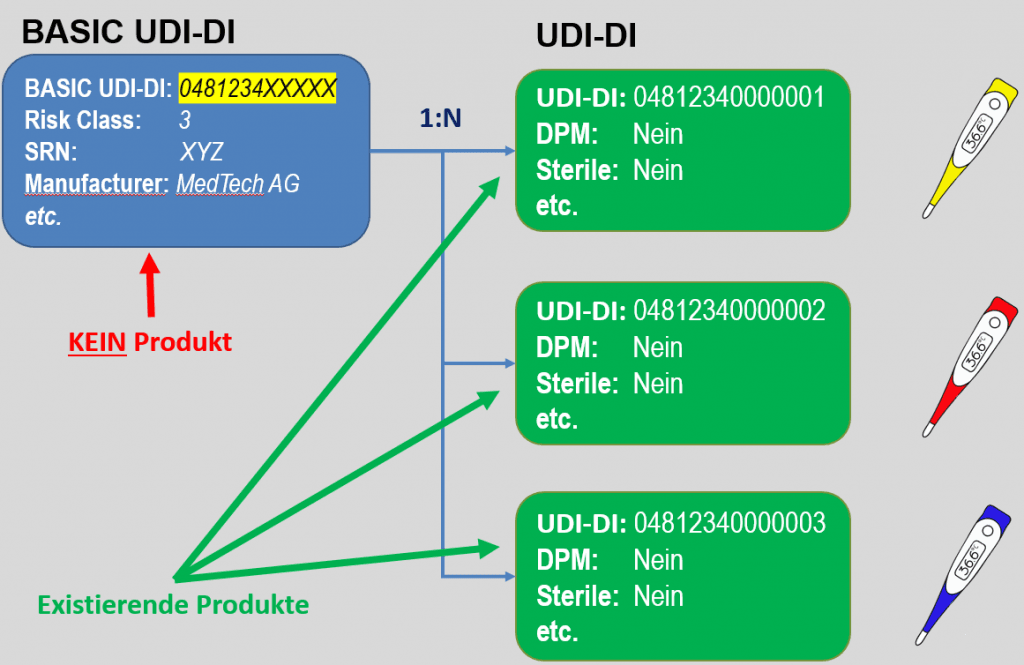
EUDAMED Basic UDI-DI and UDI-DI
Existing illustration by Europe IT: schematic assignment only; the example identifiers have not been checked. The Basic UDI-DI and product record remain separate.
Unit of Use DI
A Unit of Use DI identifies the unit of use in the relevant UDI context, especially where not every individual unit of use carries its own UDI carrier.
It may become relevant, for example, for a pack containing multiple units. Its role must be distinguished from the packaging identifier and the production-related serial number.
V
Validation
Validation must be explained in its specific context. UDI data validation checks data against the rules and structures represented in the process.
This is not automatically the same as validating software for its intended use. A data check without errors is also not a comprehensive regulatory product release.
VDP – Variable Data Printing
Variable Data Printing means printing changing content within a print process, such as a lot or serial number on labels.
Static product data and variable production data must be combined correctly. Printing, data content and checking the marking are separate tasks.
Verification
Verification checks whether specified requirements have been met.
In a data or labelling process, this may include field rules, barcode content or readability. The subject and criteria of the check must be named; the word alone does not describe a complete compliance assessment.
Vigilance
Vigilance is the system for handling and reporting safety-relevant incidents and measures in the medical-device context.
It is part of post-market product-safety activities, but must not be equated with all market-surveillance activities or with UDI registration.
Volume Production
Volume production means manufacturing larger quantities.
A high unit count is not automatically a high number of different UDI-DIs. Unit quantities, product variants and authority records must not be confused when planning the process.
W
Warnings and Precautions
Warnings and precautions provide information about relevant risks and the safe handling of a product.
In labelling, instructions for use and product data, the information must fit the intended product. Generic warning text is not a substitute for the actual product documentation.
WebTrader
WebTrader was the former FDA web interface for electronic submissions.
According to the FDA, it was replaced by the Unified Submission Portal of ESG NextGen on 14 April 2025. Old WebTrader instructions are therefore not unchanged current operating instructions.
WHO – World Health Organization
The World Health Organization is the health organisation of the United Nations.
Among other things, it publishes international health information and guidance. A WHO publication is not automatically a national UDI submission requirement.
X
XML – Extensible Markup Language
XML is a markup language for the structured representation of data.
Generating XML, checking a schema and transmitting the file are different tasks. A file can be valid XML and still not match the required authority format.
XSD – XML Schema Definition
An XSD describes permitted structures and data types of an XML document.
A successful XSD check does not prove that all substantive dependencies, permissions or authority rules are met. Schema validation and business validation must be considered separately.
Y
Yes / No – Controlled Data Values
Yes and No are typical selection values in structured records.
If a template or interface requires specific codes, they must not be replaced arbitrarily by “Yes”, “No”, “1” or free text. The concrete code list, not everyday language, is decisive.
Z
ZIP
ZIP is a file format for compressing and bundling files.
A ZIP archive is not automatically a complete Evidence Pack. Content, linkage to the data status and submission, and controlled storage remain separate tasks.
Europe IT resources: products, articles and templates
These topic-based links lead to Europe IT product information, technical articles, templates, case studies and services. This resource provides an overview; the detail pages explain particular procedures and solutions.
Company and references
UDI fundamentals and guides
- UDI Guide
- UDI terminology
- UDI barcodes and labeling
- UDI compliance
- Excel vs GSP vs GUDI
- UDI Evidence Pack
- EUDAMED error library
- UDI worldwide overview
EUDAMED
- EUDAMED overview
- EUDAMED structure
- EUDAMED links
- EUDAMED FAQ
- EUDAMED M2M
- EUDAMED SAP Add-on
- EUDAMED Excel Template
swissdamed
USA and Australia
- FDA UDI overview
- FDA GUDID links
- FDA SAP Add-on
- FDA GUDID Excel Template
- AusUDID overview
- AusUDID Excel Template
Software and submissions
- Global Submission Portal
- GSP product website
- Global UDI SAP Add-on
- UDI data submission
- UDI Excel Cloud Validator
- FDA eMDR Data Submission
SAP, consulting and services
- MedTech consulting
- Software development
- SAP Adobe Forms
- GS1 Barcode Generator
- Zebra printers in SAP
- Computer System Validation
- Outsourcing
Knowledge and case studies
Using further resources effectively
This topic index connects key specialist questions with deeper explanations and helps navigate between fundamentals, products, instructions and services. Questions about erroneous EUDAMED data lead to the error library; browser-based submissions lead to GSP; SAP-integrated UDI management leads to GUDI.
Official sources and technical documentation
This directory covers legislation, data models, registration instructions and technical information. The references complement sources linked directly within the specialist sections.
European Union: legislation and EUDAMED
- Regulation (EU) 2017/745: Medical Devices (MDR), EUR-Lex. Legal basis for many European medical device requirements.
- Regulation (EU) 2017/746: In Vitro Diagnostic Medical Devices (IVDR), EUR-Lex. Legal basis for IVDs.
- Regulation (EU) 2024/1860: gradual EUDAMED implementation. Module-specific rollout and further transitional matters.
- EUDAMED official module overview. Status and general purpose.
- EUDAMED: preparation for mandatory use. Phased implementation information.
- EUDAMED Actor Registration. Registration and basic roles.
- EUDAMED UDI/Device Registration. Device registration and data categories.
- EUDAMED Notified Bodies and Certificates. Certificate processes and roles.
- EU Unique Device Identifier (UDI). EU UDI fundamentals.
- EU European Medical Device Nomenclature. Official EMDN information.
- EU MDCG-endorsed documents and other guidance. Guidance including legacy and vigilance matters.
- EU clinical investigations and performance studies. Regulatory background for clinical modules.
- EU new medical device regulations overview. Context for regulatory changes.
Germany: BfArM, transition and national information
- BfArM EUDAMED FAQ. Practical registration and transmission questions.
- BfArM: DMIDS to EUDAMED transition. Transition and national context.
- BfArM EUDAMED: who, what and when?. Registration cases; always check the current legal position.
Switzerland: Swissmedic and swissdamed
- Swissmedic swissdamed main page. Modules and announcements.
- Swissmedic device registration. Responsible parties and procedures.
- Swissmedic swissdamed questions and answers. Practical special cases.
- Swissmedic technical documentation. Document versions and interface materials.
- Swissmedic Playground. Test environment.
- Swissmedic CHRN / actor registration. Swiss registration numbers and roles.
- Swissmedic information for importers. Linking importers to devices.
- Swissmedic Unique Device Identification. Swiss UDI fundamentals.
- Swissmedic UDI in swissdamed. Identifiers and packaging levels.
- Swissmedic swissdamed support. Documentation and contact channels.
- Swissmedic: registration mandatory from July 2026. Deadlines and context.
- Swissmedic legacy devices in swissdamed. Devices under former legislation.
- Swissmedic M2M registration. Technical information and operating conditions.
- Swissmedic medical device regulation FAQ. General obligations.
USA: FDA and GUDID
- FDA UDI Basics. US UDI fundamentals.
- FDA GUDID overview. Database purpose.
- FDA Prepare for GUDID. Preparation, roles and routes.
- FDA Request a GUDID Account. Access applications.
- FDA Submit Data to GUDID. Manual and HL7 SPL submission.
- FDA GUDID guidance. Official technical and regulatory guidance.
- AccessGUDID public search. Public Device Identifier catalog.
- FDA UDI rules and training. Training and legislation.
- FDA eMDR. Electronic adverse event reports.
- FDA Medical Device Reporting. Legal and practical framework.
- FDA eMDR FAQ. Technical and substantive questions.
- FDA eMDR troubleshooting. Error analysis and support.
Australia: TGA
- TGA UDI Hub. Central access to Australian requirements.
- TGA AusUDID. Database information.
- TGA information for sponsors and manufacturers. Roles and data management.
- TGA AusUDID for sponsors and manufacturers. Practical registration.
- TGA Australian UDI Data Dictionary. Fields and values.
- TGA UDI Guidance Documents. Rules and implementation.
- TGA Getting a UDI. Identifier assignment and issuing agencies.
- TGA AusUDID in healthcare. Use of public data.
International standards and taxonomies
- IMDRF Unique Device Identification Guidance. International principles.
- IMDRF UDI Application Guide. Applying UDI rules.
- IMDRF System Requirements for UDI in Healthcare. Different use situations.
- GS1 DataMatrix in healthcare. Carrier information.
- GMDN Agency: what is GMDN?. Nomenclature fundamentals; distinct from EMDN.
Using sources when technical and legal requirements change
First assess whether a regulatory change affects the legal obligation, data model or technical submission method. A new API document can change implementation without changing which devices require registration. Conversely, a new transitional rule can affect planning without changing the file format.
For each important source, record which statement it supports and when it was last checked. A current authority notice can supplement or supersede earlier guidance. Publication dates matter especially for deadlines and technical versions. Key sources are the European Commission for EUDAMED, Swissmedic documentation for Switzerland, FDA GUDID documents for the USA and TGA Data Dictionary for Australia.
Recent additions on SS(C)P and implementation dates
Europe IT Consulting GmbH · UDI Knowledge Center · Information reviewed as of 17 November 2026. Official sources are linked within the relevant topics and in the source directory.