
Mastering EUDAMED UDI Registration – Where to Start & How to Overcome Uncertainties?
For many manufacturers, registering medical devices in the European database EUDAMED feels like a mammoth project: new roles, new data logic (Basic UDI-DI/UDI-DI), high requirements for data quality – and the worry of doing something “wrong.” That is precisely why a systematic approach pays off: first, set up the foundations properly, then learn with a pilot product, and finally scale up.
A crucial milestone for planning: the use of the first four EUDAMED modules will become mandatory starting 28 May 2026 (including Actor Registration, UDI/Devices, Notified Bodies & Certificates, Market Surveillance). https://health.ec.europa.eu/latest-updates/eudamed-four-first-modules-will-be-mandatory-use-28-may-2026-2025-11-27_en?
Where to Start: Preparation, Access, SRN
The best way to start is not by simply “typing in” data, but by creating a stable foundation:
-
Secure Actor Registration and SRN: The Single Registration Number (SRN) is the key to almost all subsequent processes. Without it, your workflows will come to a standstill.
-
Clarify the Role Model: Who is the “Local Actor Administrator”? Who is authorized to release data? A clear role concept prevents bottlenecks during publication.
-
Understand the UDI Hierarchy: Before you start collecting data, there must be internal agreement on the structure.
| Level | Function | Example |
| Basic UDI-DI | Group key (model family) | A family of cardiac catheters |
| UDI-DI | Specific variant / packaging | Catheter size 5Fr, sterile packaged |
| UDI-PI | Dynamic data (production) | Batch, serial number, expiry date |
Clarify essential basics:
-
Classification of your products according to MDR/IVDR: MDR (EU) 2017/745 and IVDR (EU) 2017/746.
-
Selection of an EU-designated UDI Issuing Entity: Issuing entities (GS1, HIBCC, ICCBBA, IFA).
-
Structuring your product hierarchy: Basic UDI-DI (group key) and UDI-DI (specific variant/packaging level) as well as UDI-PI (Production Identifier)
The 3 Most Common Uncertainties – and Their Solutions
1. Which data is actually required?
EUDAMED registration requires structured product information (including description, classification, intended purpose, variant logic, packaging/configuration details). In practice, it rarely fails due to “too little knowledge,” but rather due to a lack of systematic approach.
How to solve this:
-
Create an internal data checklist (MDR/IVDR serves as a reference, including Annex VI; see MDR/IVDR above). To do this, read the EU documents Document 32017R0745 and Document 32017R0746.
-
Define a Minimum Viable Product (MVP) data set for the start: Which fields must be completely filled out for a pilot product?
-
Determine for each data field which source is the “Single Source of Truth” (ERP/PLM, Labeling, Technical Documentation, RA Master Data).
2. When must registration take place (– and what is urgent)?
This is often confused: UDI labeling/implementation (label/carrier) is partly dependent on risk class and product, but there are clear milestones for the use of EUDAMED modules. For project planning, the following is most important:
- Establish EUDAMED readiness (roles, SRN, processes, data quality) early on.
- Do not wait until “everything is perfect” – instead, pilot, learn, and scale.
For classification of the modules and the deadline: EUDAMED Overview and the official announcement regarding mandatory use starting 28 May 2026: First four modules mandatory from 28 May 2026
3. How do I handle product variants?
Variant logic is one of the biggest stumbling blocks. Basic principle:
- Basic UDI-DI: Group key (typical for devices with the same intended purpose/design).
- UDI-DI: Identifies specific variants/packaging levels.
How to make it manageable:
-
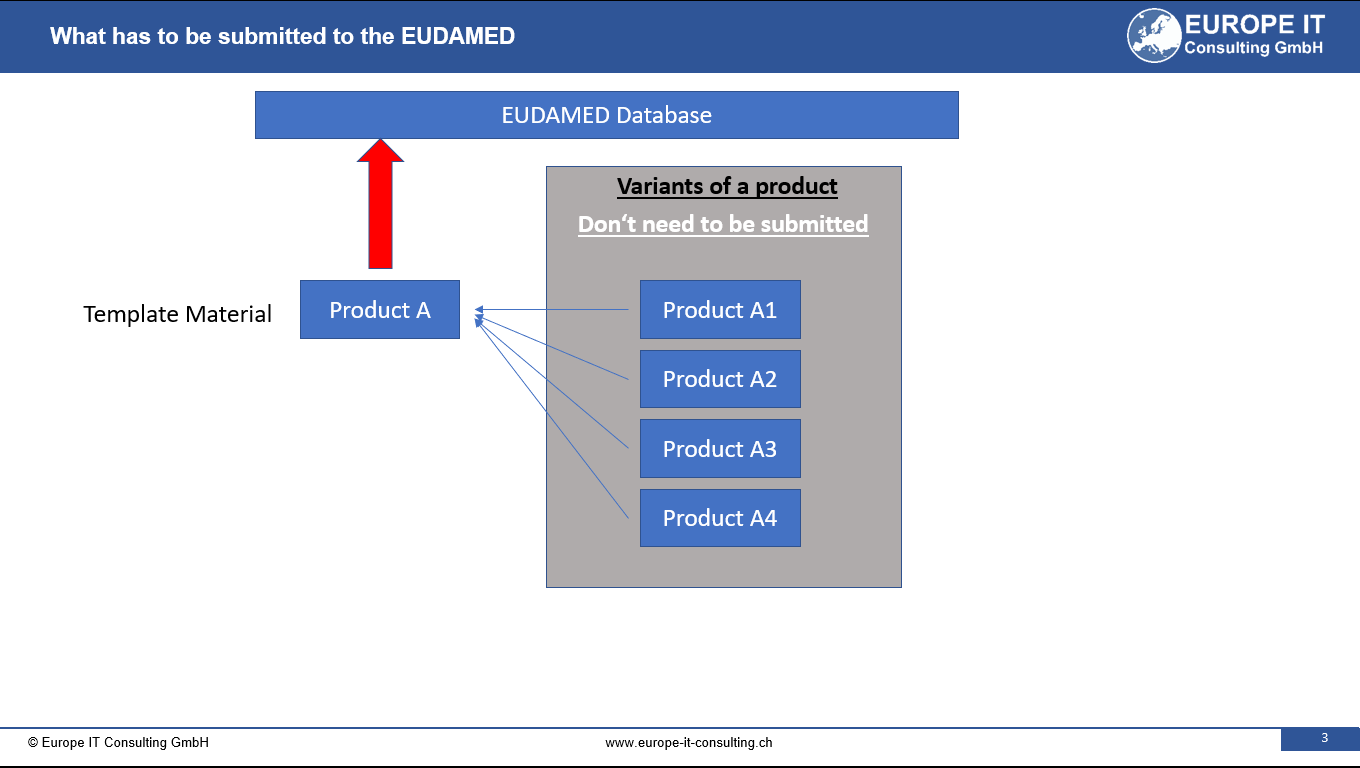
Define internally which differences trigger a new UDI-DI (e.g., clinically/technically relevant changes, new configuration, new packaging level).
-
Document these rules as a “Variant Policy” – so that decisions are repeatable and audit-proof.
Practical Tips for a Smooth Process
- Ensure data quality (before you upload)
The most common source of error is inconsistent, incomplete, or contradictory data. Establish internal validations (mandatory fields, code lists, allowed values) before uploading “in bulk.” - Plan IT integration
Many manufacturers significantly reduce effort and error rates when data from PLM/ERP is structurally mapped and pre-validated – especially with many SKUs/variants. - Team Setup and Training
UDI/EUDAMED is interdisciplinary: RA/QM, Product Management, Labeling, IT. Ensure a common understanding of terms (Basic UDI-DI vs. UDI-DI vs. UDI-PI) and clear approval paths. - Use the test environment consistently (Playground)
Use the Playground to test roles, processes, and data flows. Important: The Playground contains valid, but fake data (including Actor ID/SRN) and is not transferred to the production environment. Official explanation: EUDAMED environments and Getting started (Note on dummy data).
For actual data entry in the UDI/Devices module, these official pages are helpful:
Don’t Forget Continuous Maintenance
Initial registration is only the beginning. Product changes, new variants, label updates, or organizational changes must be accurately reflected in EUDAMED. Therefore, define:
-
Responsibilities for ongoing maintenance (Owner, deputy)
-
Change process (when/who checks, who publishes)
-
Regular data checks (quality, consistency, completeness)
EUDAMED UDI registration is not a “form issue,” but a data and process project. If you start cleanly with SRN/roles, learn with a pilot product, and then roll out in waves, uncertainty will turn into a controlled rollout – audit-proof and efficient.







Related Posts